Walking Astoria #10

I am back in Astoria.
A few weeks ago I was standing on Pnyx, the place where Athenian citizens stood and spoke before the Assembly.
This morning I was walking by the East River.
Which, as I have already established, is not a river.
And I was thinking about Athens.
Again.
On my first walk, I took a picture of the map of Astoria Park: You are here.
And that sent me to the question: Why Athens?
Why did philosophy, geometry, the assembly, the jury, democracy, theatre, medical diagnosis, and history as rational inquiry all become so embedded in everyday life in Athens?
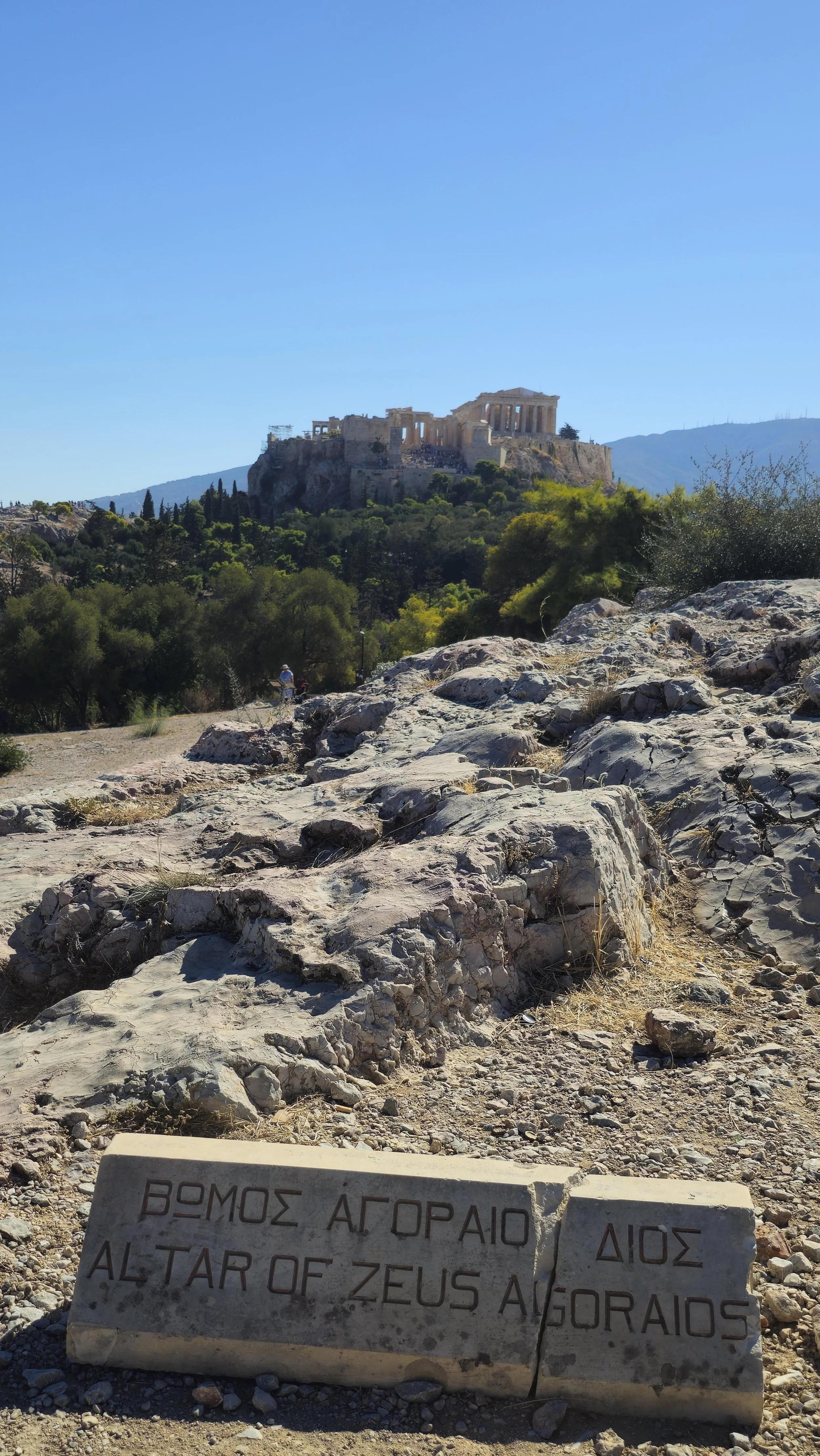
And no, the answer is not that the Greeks, or the Athenians, invented everything.
We know better than that.
But Greece is thought of as some kind of intellectual Big Bang: Before it, darkness. Then suddenly tragedy, philosophy, proof, assembly, jury, democracy, history, and the questions about life, the universe, and everything.
But we know better.
A long time ago, before Hippocrates, before the oath that doctors around the world take, there were physicians in a land far, far away: the land of Egypt.
And they examined their patients.
And they wrote down what they saw, what they concluded, and what they expected to happen.
In the Edwin Smith Papyrus, around 1600 BCE, more than a thousand years before Hippocrates was even born, there are forty-eight cases of injury, from the head downward.
And in the land the ancient Greeks would later call Mesopotamia, "between the rivers," physicians kept a handbook of their own, written on forty clay tablets. They called it Sakikkū: "symptoms."
In it, symptoms were observed, sorted, and used to predict what would happen next.
Yes, Gods, ghosts, and demons could be part of the explanations.
But observations were there.
And classifications too.
And predictions.
Of course, no one can claim that this is the same as Hippocratic diagnosis.
But also, nobody can claim that Egypt, frozen in time, was waiting for the Greeks to invent everything.
And in the Code of Hammurabi, around 1750 BCE, Babylonian surgeons are informed what will happen to them in case of malpractice: A surgeon who killed a patient with his bronze lancet should lose both his hands.
But Mesopotamia is also causing trouble for another part of the story: Argument.
Long before Plato wrote dialogues and Socrates counterargued against Protagoras, thousands of years earlier, people were already writing on opposing voices.
In the Babylonian Theodicy, one can find disputations on:
Why bad things happen to good people,
why the wicked can succeed,
or whether being religious or fair actually makes a difference.
And in Sumerian literature one can find other debates.
The Fish arguing with the Bird.
Winter with Summer.
The Sheep with the Grain.
And the Hoe with the Plough.
Yes. Somewhere, more than three thousand years ago, somebody decided that what the world needed at that moment was an argument between the hoe and the plough.
And then there is Gilgamesh.
Older than the Theodicy.
In the Sumerian poem, Gilgamesh and Aga, from around 1800 BCE, the king of the city of Kish, send messengers to the city of Uruk. The king demands that Uruk surrender to him.
Gilgamesh does not decide what to do by himself.
He brings the question to the elders of Uruk.
And the elders say, "Submit."
But Gilgamesh does not like the answer.
So he brings the same question to the younger men.
And the young men say, "Fight."
And that is the answer Gilgamesh likes.
Two assemblies, with two opposing answers.
And the king chooses. The answer he wanted, of course.
And we see the same pattern repeating later, in the Epic of Gilgamesh.
Before Gilgamesh sets out on his journey to the Cedar Forest, he asks the elders of Uruk, who warn him against it.
But he goes anyway.
And you can tell that these are not democratic debates.
Nobody is voting.
And there is a higher authority that decides.
So we cannot say: Aha! Democracy in Mesopotamia!
That would be ridiculous.
Thorkild Jacobsen came close to this conclusion. When in 1943 he read Gilgamesh and Aga, he presented it as evidence of a "primitive democracy": a council of elders and an assembly of the city's men.
Yes, but the assembly advises. And the king decides.
But, on the other hand, I also cannot say that argumentation suddenly appeared out of thin air in Greece.
Argumentation was already there before.
And then mathematics makes the story even more apparent.
Although mathematics is supposed to be safe territory.
The Egyptian scribe Ahmose copied what we call the Rhind Mathematical Papyrus centuries before classical Greece.
Babylonian scribes were doing sophisticated mathematics even earlier.
YBC 7289 is a small clay tablet with an accurate approximation of the square root of two.
Plimpton 322, another 3,700-year-old Babylonian clay tablet, has numerical relationships between the lengths of the sides of right triangles. They are, in a way, applications of the Pythagorean Theorem.
Long before Pythagoras and his theorem.
So when we say “Pythagorean theorem” and we imagine the relation between the sides of a right triangle appearing for the first time inside the head of one single Greek man, we have already failed to understand.
But we shouldn't exaggerate in the opposite direction either.
The fact that the Egyptians and the Babylonians already had mathematics does not mean that nothing important happened later in Greece.
The Rhind Papyrus is mathematically sophisticated. And Babylonian mathematics is sophisticated also.
But then you open Euclid's "Elements."
Definitions.
Common notions.
Postulates.
Propositions.
Proofs.
Show me why.
Not only: can you get the answer?
But also, can you derive it from the premises?
A theorem is a proposition that must be proven.
Now, that is a difference that matters.
And now the question becomes even more interesting.
Because the question is no longer about mathematics. At least not about mathematics only.
It's about what kind of a society expects an answer to look like this.
What kind of a society expects someone to provide a proof about a mathematical conclusion?
And what kind of a society demands a public demonstration of that proof?
And once you think about it this way, the YBC 7289 tablet changes right in front of your eyes.
You stop focusing on the square root of two on the tablet.
Yes, the tablet survived, but then the room around it did not.
The scribe is long gone.
And the person who taught the scribe is also gone.
And whatever school, workshop, temple, palace, or any kind of administrative or other world that allowed that calculation to exist is gone too.
But we do want to know about the room.
For example, who was in it?
Who else was there?
And what were they trying to do?
What counted as a good answer in there?
Could somebody say, "I disagree. I am still not convinced?"
And if somebody did say that, who got to decide whether more explanation was needed?
Or that this disagreement was a sign of disrespect or even blasphemy?
And then, "Dialogue of Pessimism" came to my mind.
"Dialogue of Pessimism" is a Babylonian poem from around 1000 BCE that explores the meaninglessness of human actions through a circular conversation between a master and his slave.
It is written in Akkadian cuneiform and is one of the oldest works of existential and satirical literature in history.
The master proposes doing something.
And the slave gives him reasons to do it.
Then the master changes his mind.
And the servant immediately gives reasons for this new proposition.
It is almost Beckettian.
And of course it caught my attention.
Yes, it is a fact that the servant can argue beautifully, but he still does not get to decide anything.
The master does.
And now we are looking at the argument differently.
Not only: are there two sides?
But: who gets to close the argument?
Who has the authority to say, "This is what we are doing"?
I kept walking.
And then there is the alphabet.
The word "alphabet" is Greek. It is composed of the names of the first two Greek letters: "Alpha" and "Beta."
But the words "Alpha" and "Beta" do not mean anything in Greek. They are just the names of the letters.
But they mean something in another language: Phoenician.
The Greek letter "Alpha" comes from the Phoenician letter "Aleph" (𐤀), which derived from an ancient pictograph of the head of an ox with horns. And the West Semitic word for "ox" was "ʾalp."
When the Greeks adopted this letter, they turned it upside down to create "Alpha," which later eventually became the Latin letter A.
"Beta" comes from the Phoenician letter "Beth" (𐤁), derived from a pictograph representing the floor plan of a multi-chambered nomadic tent or house ("bayit"). The Greeks adapted it as "Beta," which became the letter B.
The Greeks adapted the West Semitic letters the Phoenicians used.
But the Greeks made one enormously consequential change: they used some of the letters as vowels.
But Phoenician letters were not original either.
Phoenician belongs to an older array of alphabetic experiments between Semitic-speaking communities in contact with Egyptian writing.
The originals were Egyptian pictographs.
So, the lineage is:
Egyptian into West Semitic.
West Semitic into Phoenician.
Phoenician into Greek.
A Western Greek alphabet into Etruscan.
Etruscan into Latin.
And Latin into English, among others.
The letters I am using now have a long evolutionary history.
So, like the alphabet, which didn't begin in Greece, and like the Pythagorean theorem, Athens did not begin in Athens.
And its mathematics did not begin there.
And medicine did not begin there.
And argument did not begin there.
And law, administration, schools, diplomacy, archives, councils, trade networks, religious interpretation: None of these was sitting around waiting for the Greeks to invent it.
But this makes Athens even more interesting to me, not less.
Yes, the miracle disappears.
But that's a good thing.
Miracles are the worst explanations.
Actually, saying "this is a miracle" is admitting there's no explanation.
But how did I end up here?
Why is it that I can see these connections? Why is it that I can ask these questions?
My first degree is in Mathematics.
And my focus was on the History, Philosophy, and Education of Mathematics.
This led me to pursue a graduate degree in the History and Philosophy of Science and Technology.
Which, in turn, led me to Teaching and Learning, which is my PhD.
And my dissertation explored, through Theatre, the social implications of science and technology, and specifically of Artificial Intelligence.
How student critique, a dialectical process used by Art Studios in the Renaissance, could be applied in the teaching of Science, Technology, Engineering, and Mathematics education.
Because I have also studied Theatre Acting and Directing.
And perhaps the seed for my main question came from theatre.
The theatre I love is the theatre that Martin Esslin named "The Theatre of the Absurd": Beckett, Pinter, Ionesco, and, somewhere farther down the same road, Stoppard.
Why do I love this theatre?
And why does theatre have traditions at all?
Ancient Greek Tragedy and Comedy.
Roman Theatre.
Indian Sanskrit Drama.
Japanese Noh Theatre.
Japanese Kabuki.
Chinese Jingju (Beijing Opera).
Italian Commedia dell’arte.
Shakespeare and English Renaissance Theatre.
French Neoclassicism.
European Melodrama.
Russian Realism.
French Naturalism.
German Expressionism.
Brecht and Epic Theatre (also German).
Theatre of the Absurd (developed out of the Parisian avant-garde scene).
Postmodern Theatre (Western Europe & United States).
Why does theatre change?
Why was "Waiting for Godot" possible only in the twentieth century, after World War II and the Holocaust, and not even conceivable in fifth-century Athens?
Why did Aeschylus write tragedies and not Commedia dell’arte?
And why wasn't it Shakespeare who wrote, "Rosencrantz and Guildenstern Are Dead?"
Theatre has a history.
Theatre is evolving.
Within societies.
It is evolving along with them.
Forms survive.
Change.
Get attacked.
Combine with other forms.
Sometimes they disappear.
And the world around them changes too.
Different audiences. Different institutions. Different technologies. Different fears. Different things that can be said, and different things that cannot.
Later I read Arthur Danto’s "The Transfiguration of the Commonplace."
And I loved the question more than the answer.
Two objects can look physically indistinguishable and still be completely different things.
Because they belong to different conceptual worlds.
One can be art.
The other can be an ordinary mass-produced object.
So whatever art is, it is not sitting entirely inside the physical object.
The history around it matters.
The interpretation matters.
The artist's intention matters.
The world around the object matters.
And then the question became larger. It expands.
If this happens to art, what else does it happen to?
Religion obviously has a history.
Political institutions have a history.
Science has a history.
Theatre has a history.
What about the categories through which we understand the world?
They also have a history.
What about the categories through which we understand ourselves?
They too have a history.
And this history is actually a social history.
We are political animals.
Aristotle defined us like this.
So, we do evolve like other animals because of the pressures of our natural environments.
But what about our ideas?
How do they evolve?
They evolve through the pressure of our social environments.
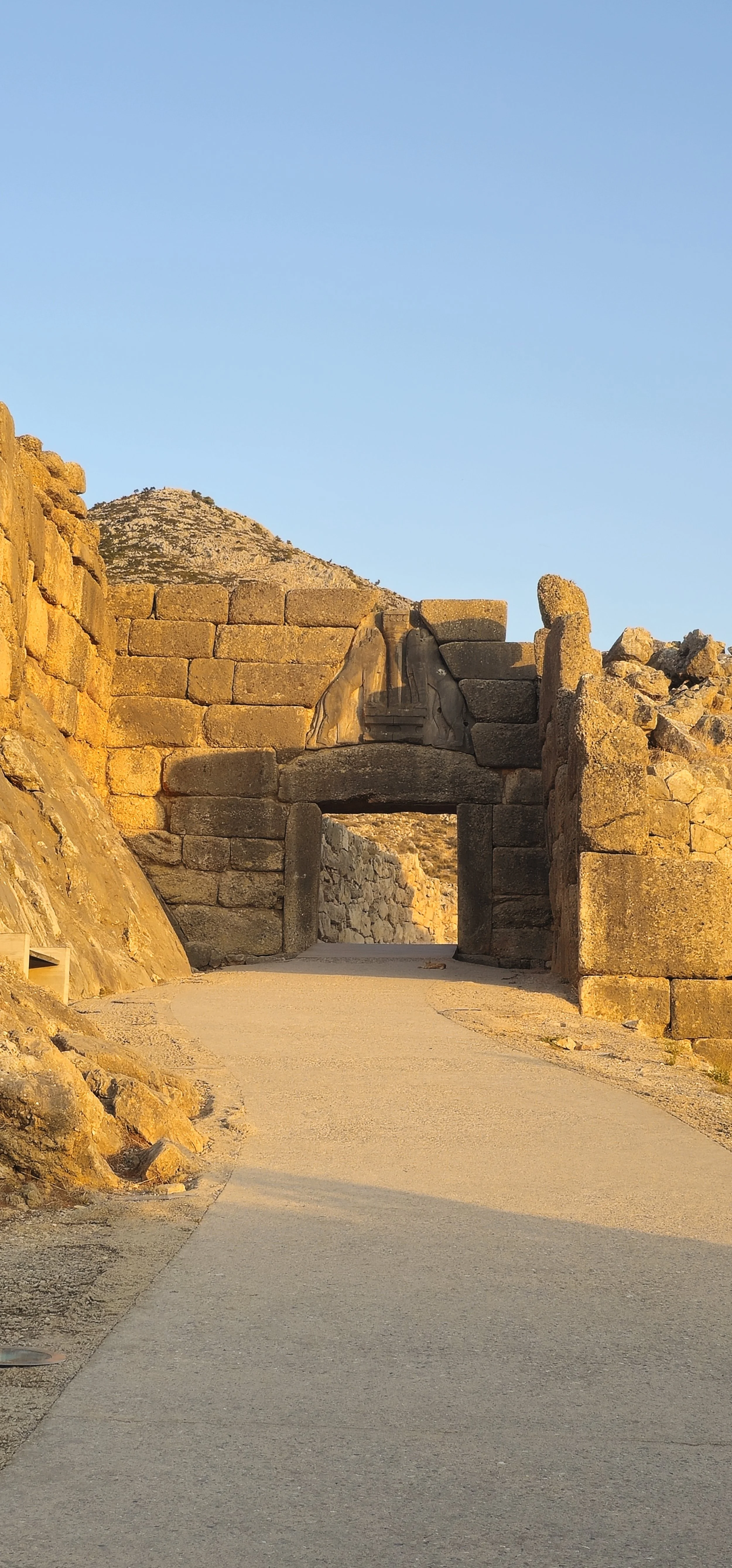
This is my main hypothesis: We evolve through natural selection, our ideas evolve through social selection.
And which is the hardest case to defend, you ask?
Mathematics.
A king cannot order a theorem to be true.
A parliament cannot pass a law making the square root of two a rational number.
And we cannot vote the angles of a Euclidean triangle into adding up to 360 degrees.
Excellent.
If my hypothesis fails when applied to mathematics, then I cannot claim that it applies to all ideas.
But if it survives mathematics, the case that seems least vulnerable to social pressure, then it has survived the hardest test I can think of.
That does not prove it for everything else, but it earns the right to be tested there too.
And it gives me more reason to think it will survive there as well.
And I don't claim that society manufactures mathematical truth.
That's not what I mean.
The square root of two does not care whether the person proving something about it lives under a king, a democracy, or a dictatorship.
But the mathematician does.
The mathematician has teachers. Has a language. Has symbols available. Has problems that other people around consider worth solving. Has, or does not have, the time to sit and think.
Who gets to decide what mathematics should be taught to the next generation?
And who is allowed to learn it?
Why was this problem worth preserving?
What kind of answer satisfied the people who used it?
Why was Euclid possible in the Hellenistic Era?
What do the floods of the Nile have to do with the Egyptian origins of geometry?
What kind of mathematics does a bureaucratic society like Babylon produce?
Or what kind of mathematics did the Cold War produce?
Or would it surprise you that during Mao's Cultural Revolution, abstract mathematics was attacked as "bourgeois," cut off from the daily labor of peasants and workers?
Or that Nazi Germany had a movement, "Deutsche Mathematik," that rejected abstract mathematics as "Jewish" and wanted to replace it with the proper "Aryan" mathematics?
What was changing?
And what was happening, at the same time, to argument, law, medicine, education, science, art, theatre, historiography, authority, governance?
This will be my method.
Picking up a mathematical fossil: a Babylonian clay tablet, an Egyptian papyrus, an Inca khipu, a page from Brahmagupta, al-Khwārizmī's algebra, the page of Euclid's "Elements," postulates, a navigation chart, a page from Newton, Manhattan Project calculations, a neural network diagram.
Understand it.
Look around it.
What else is happening?
Then keep walking.
Athens is still here.
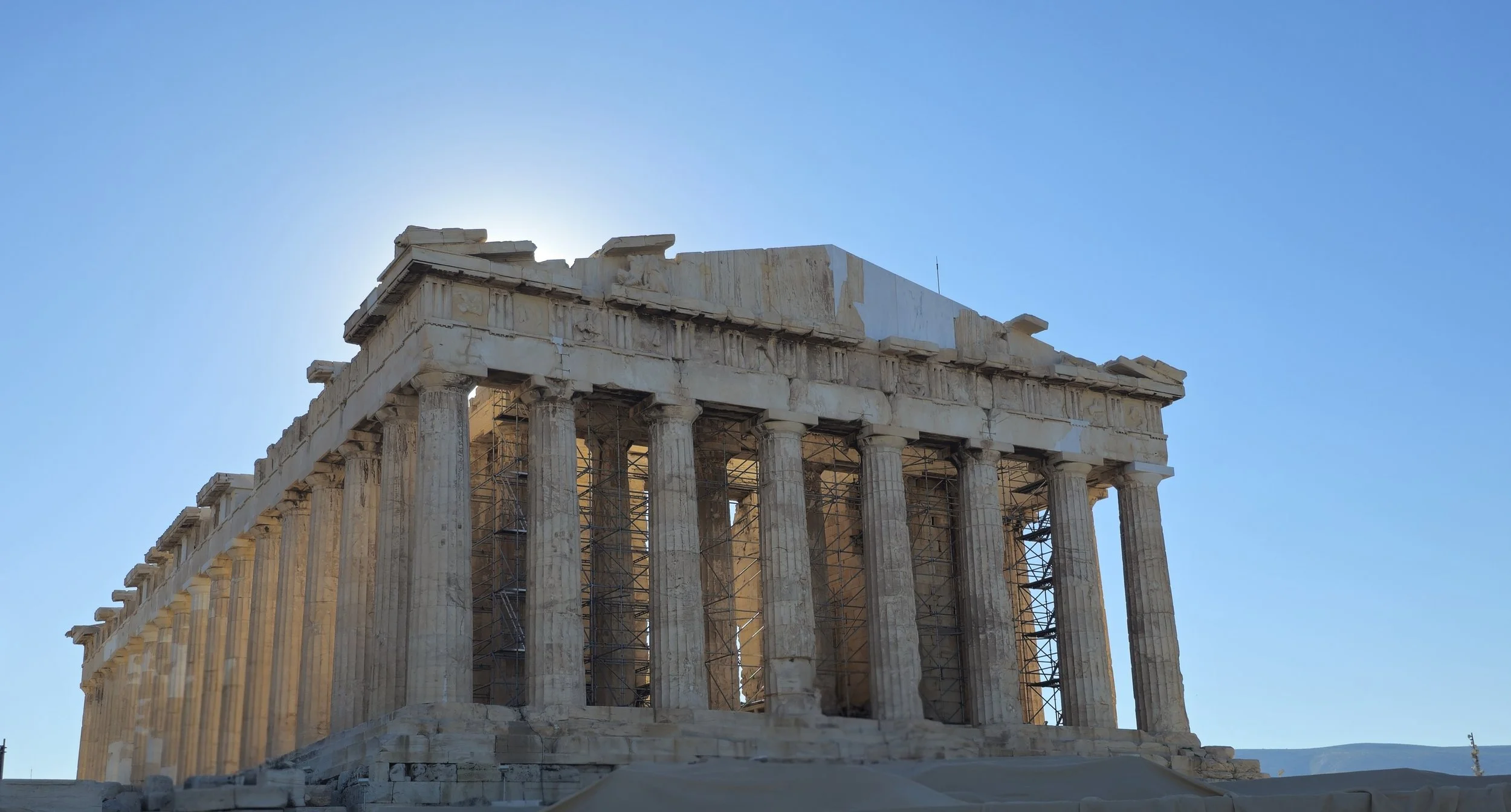
But now there are arrows pointing toward it from Egypt, Mesopotamia, Phoenicia, Persia, the wider Mediterranean, maybe even the Indus Valley.
And there will be arrows leaving it too.
So the question is no longer where Athens came from.
The question is what happened when all those roads met there, and what happened afterward when some of what emerged there began traveling again.
I am back in Astoria.
And Athens, turns out, is not the beginning.
It is a junction.
An amazing junction.