Walking Astoria #1, August 10, 2026
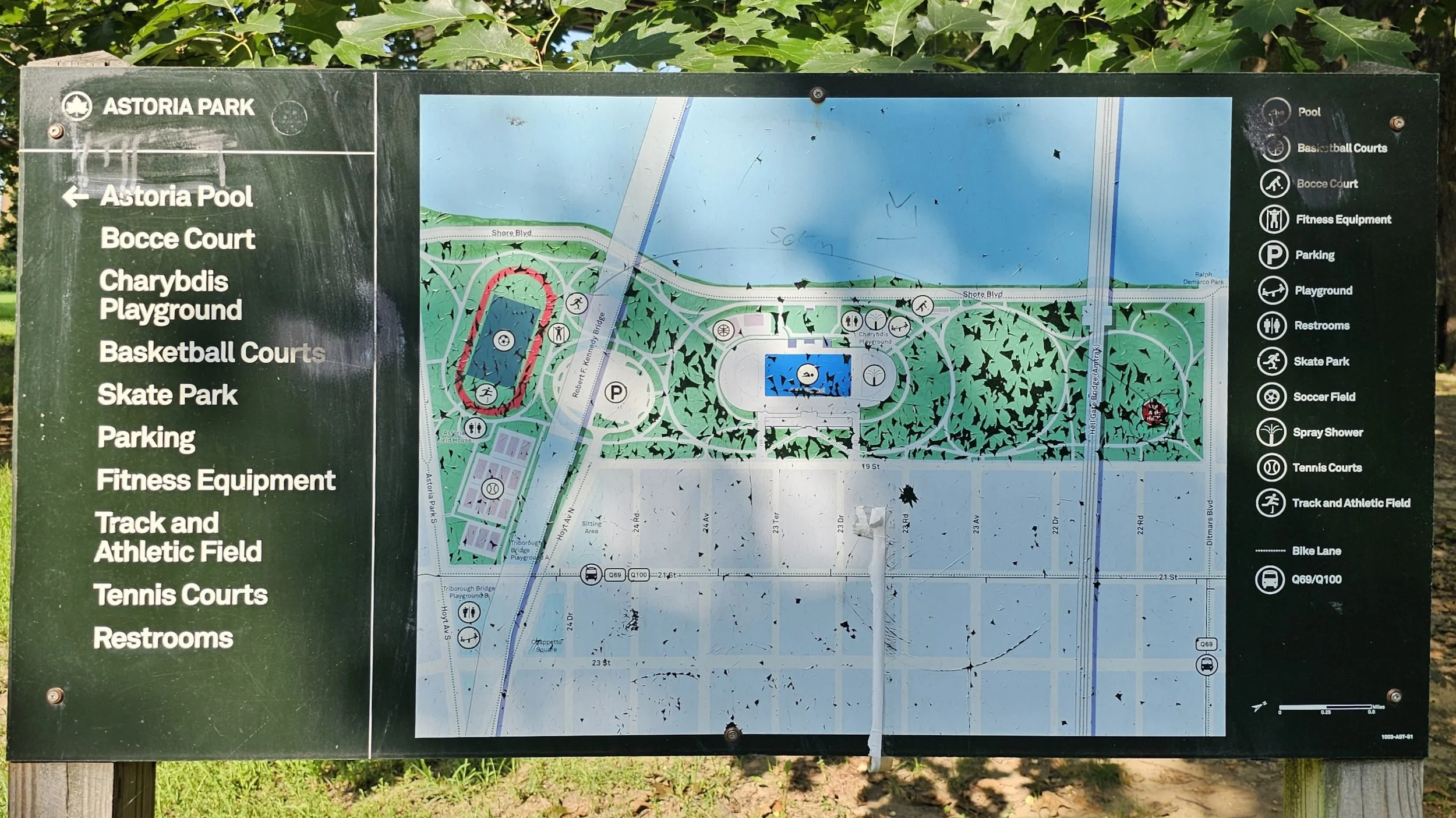
The map of Astoria Park.
I took a picture of a map today, on my first walk.
It’s one of those maps in Astoria Park that most people probably pass without looking at. It has started peeling off. The pool is here. The basketball courts are there. The East River is over there.
You are here.
And while I was walking, I started thinking that perhaps this is one of the most basic things human beings do.
We make maps.
Not only maps of places.
A myth is a map. A religion is a map. A history is a map. A philosophy is a map. A scientific theory is a map. Mathematics gives us maps of structures that we cannot even see. Ethics gives us maps of what we should do. Politics gives us maps of how we should live together.
They are obviously not the same kind of maps. Some are tested against reality more aggressively, more rigorously, more scientifically than others. Some can be revised, some are set in stone, and some become sacred. Some tell you where you are, and some tell you that you are where you wish you were. Some were inherited from your ancestors, and some you have created yourself. Some are legitimate, while others are used by scammers to scam you.
But they all try to perform something similar: there is an enormous, complicated territory out there, and we need some way of navigating it.
Where am I? How did I get here? Where did we come from? What should I do next?
And then another thought occurred to me:
Isn’t this what education is?
We are born into a world already covered with maps drawn by people who are dead.
Language is a map. Stories are maps. Mathematics is a map. History is a map of the paths by which we arrived here. And education is how those maps are passed from one generation to the next.
But good education cannot merely hand the child the map and say, “Follow this.” That has a different name: indoctrination.
Good education must eventually say: “Here are the maps we inherited. Here is why they look this way. Here are the people, the communities, the civilizations who drew them. Here are the places where they were wrong. And here is a pencil.”
I think this may explain something about my own life. My first intellectual excitement was mathematics, but almost immediately mathematics took me backward, toward the history and philosophy of mathematics. I was fascinated by the Presocratics. What struck me was not simply Thales, or Heraclitus, or Parmenides individually. It was the multitude of them. Everyone seemed to be proposing another map of reality. Another beginning of everything. Another ultimate first principle, source, or primordial substance of the natural world. Another archē:
Water. The boundless. Air. Fire. Number. Earth, water, air, and fire. Atoms and void. Change, balance, and order. Logos.
And these maps were colliding. They were debated. There was a contest, a struggle, a competition between them: an agōn of explanations.
Years later, I began asking the question that now occupies much of my work: how did this extraordinary torrent of competing thought eventually become part of the same environment in which mathematics, philosophy, theatre, democracy, history, medicine, ethics, and the popular jury developed and flourished so intensely?
Why Athens?
And then another map came to mind. One I created while studying mathematics at the University of Patras, Greece.
I was thinking about the coordinate plane. And the graph of the function f(x)=1/x. Which is a hyperbola, and has two branches. And that bothered me. Why is it split in two? Could there be something we are missing in how we represent it? How do we map it on the coordinate plane? This break happens because of the side limits at zero. And we use 0+ and 0-, which is the same point on the x-axis, just approached from the right or from the left. And then it struck me: what if when we say +∞ we mean that infinity is approached from the left, and when we say -∞ we mean that infinity is approached from the right? That would turn the coordinate plane into a sphere with infinite radius. And look at what happens to the hyperbola: it closes. And it becomes, topologically, the symbol of infinity: ∞.
I was enormously excited.
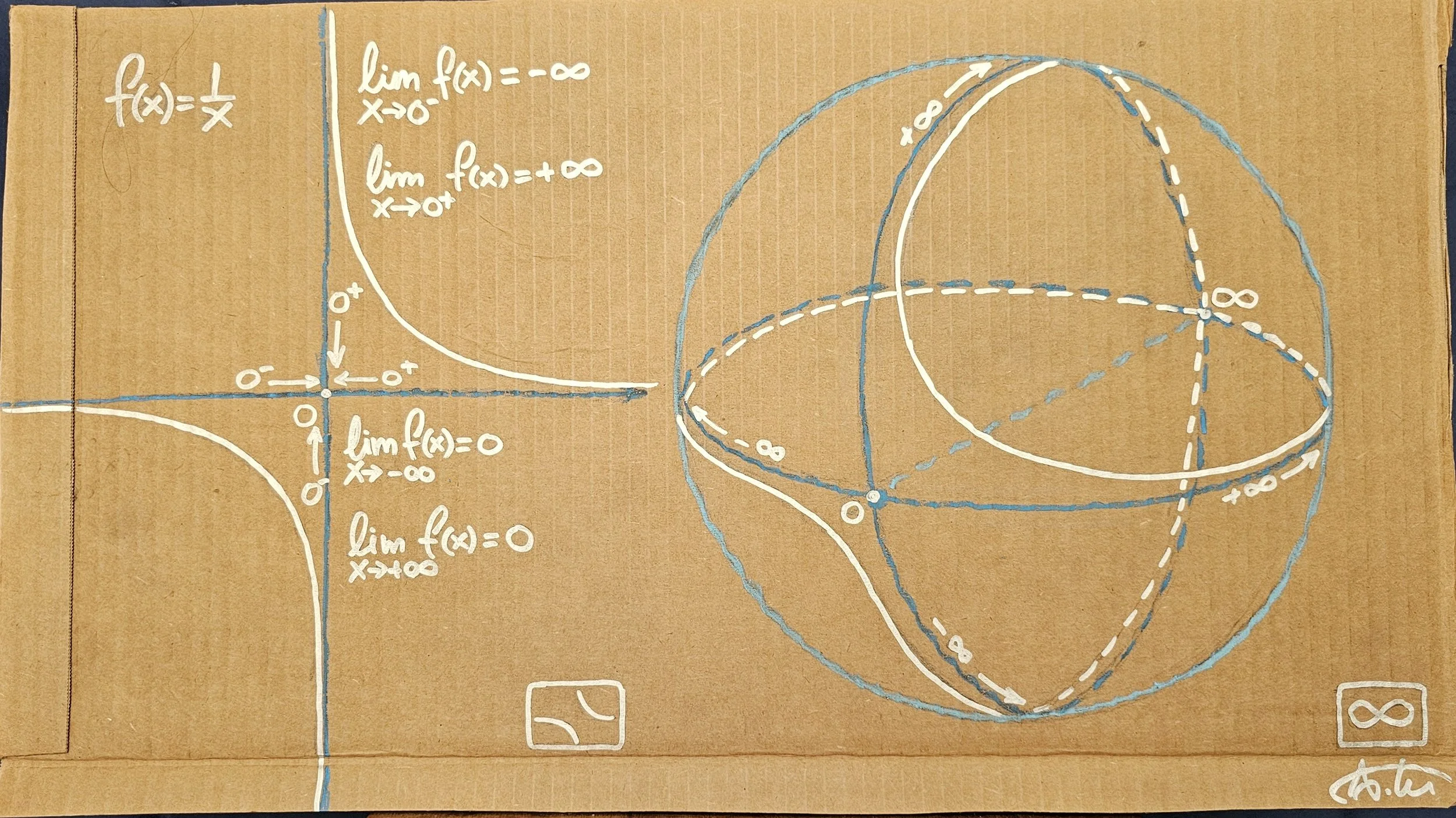
My map: the graph of f(x)=1/x on the plane, and my attempt to see it on a sphere.
I went to the professor I admired and explained what I was thinking. He suggested I speak to someone in topology. And I did.
The response was quick and dismissive: something about geodesic coordinates, if I remember correctly. Whatever he understood me to be asking was not what I was asking.
So I left it there.
Years later, a friend of mine, whom I had once directed in Beckett’s “Endgame” at the theatre club when studying mathematics, reminded me of the idea. He had continued his studies in London and eventually became an economics professor. “Remember that thing you told me back then?” he said.
It turns out that what I had imagined already had a name: the Riemann sphere; the extended complex plane you get by adding a point at infinity. In topology, the broader construction is called one-point compactification.
Someone had already drawn my map.
Of course, that did not mean I had discovered new mathematics. That was the picture I had constructed in my head. It was not the formal mathematics, but I discovered years later that the topological idea behind it was real.
The Riemann sphere goes back to nineteenth-century complex analysis, while Pavel Aleksandroff later formulated the general one-point compactification.
But that wasn’t the point.
The point was that, as a student, I had independently walked far enough through the territory to arrive at a real mathematical landscape. And nobody had told me: “Keep walking.”
I sometimes wonder what would have happened if someone had.
Perhaps I would have continued into graduate mathematics. Instead, I went toward the history and philosophy of mathematics, and then theatre, history and philosophy of science and technology, and education: teaching and learning.
I do not regret taking the path I took. I’m grateful. But I promised myself that as a teacher, when a student brings to me a strange idea, I will not begin by telling them why it is wrong, why it cannot be done, or why it is irrelevant. I will ask them: What map are you trying to draw?
Because from time to time some students might think they are lost when they have actually wandered off the map available to them. And maybe they are onto something.
And perhaps that is my origin story.
I began with mathematics. Mathematics led me to philosophy. Philosophy led me backward toward the Greeks. Theatre led me back there from another direction. Education led me back again.
And eventually all those paths produced the same question:
What happened in Athens?
Why did so many different ways of mapping reality begin interacting there? Did each different map act as a catalyst for every other map to evolve faster? Is there a common core in all of those? Is there a common archē?
That question of that archē has now become, in my mind, a book.
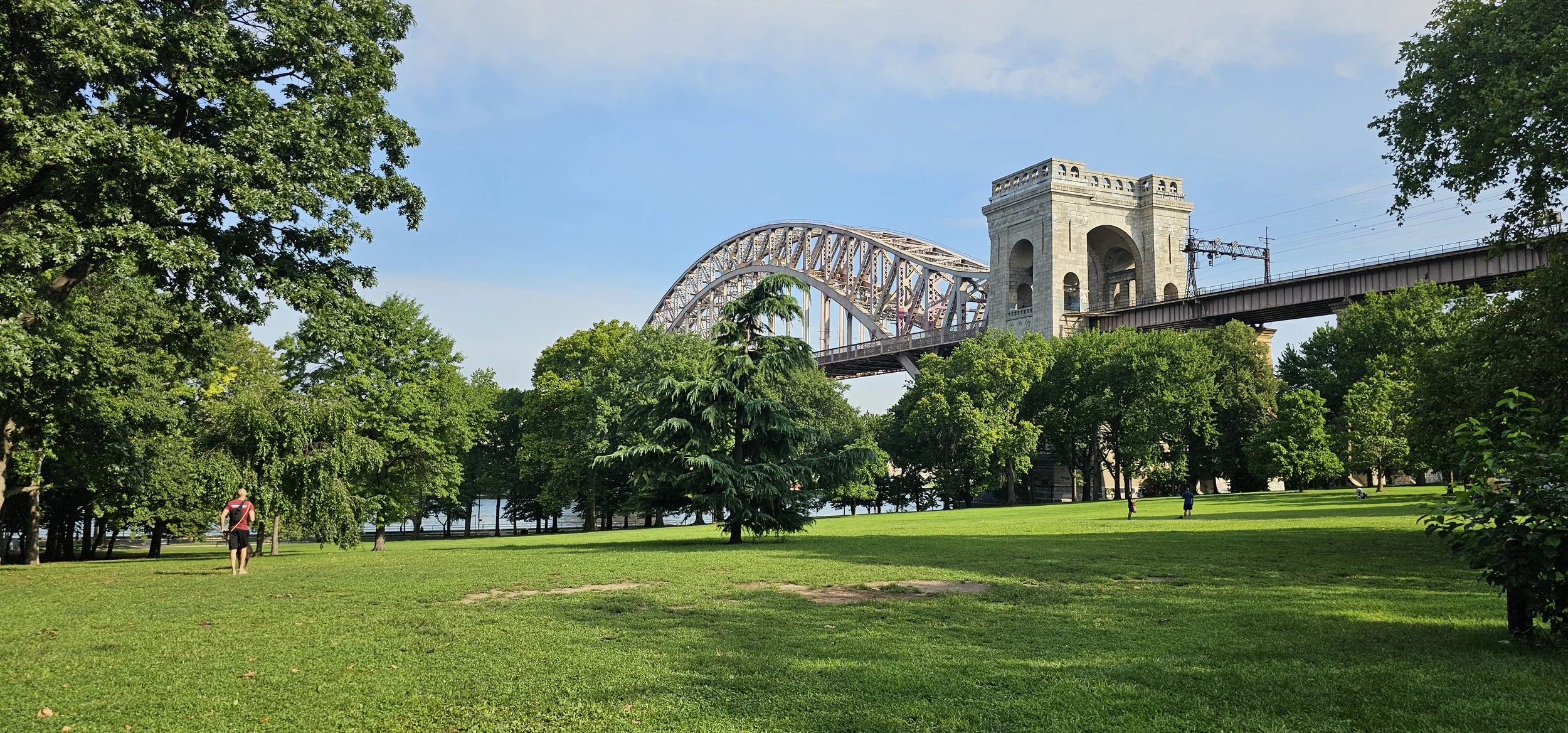
Astoria Park and the Hell Gate Bridge.
And I have decided that every day I will be walking in Astoria, thinking about the book I am writing.
And today, walking through Astoria Park for the first time, I took a picture of its map. Only afterward did I realize why.
You are here.
And I suppose everything I am doing now begins with me trying to understand what “here” even means.