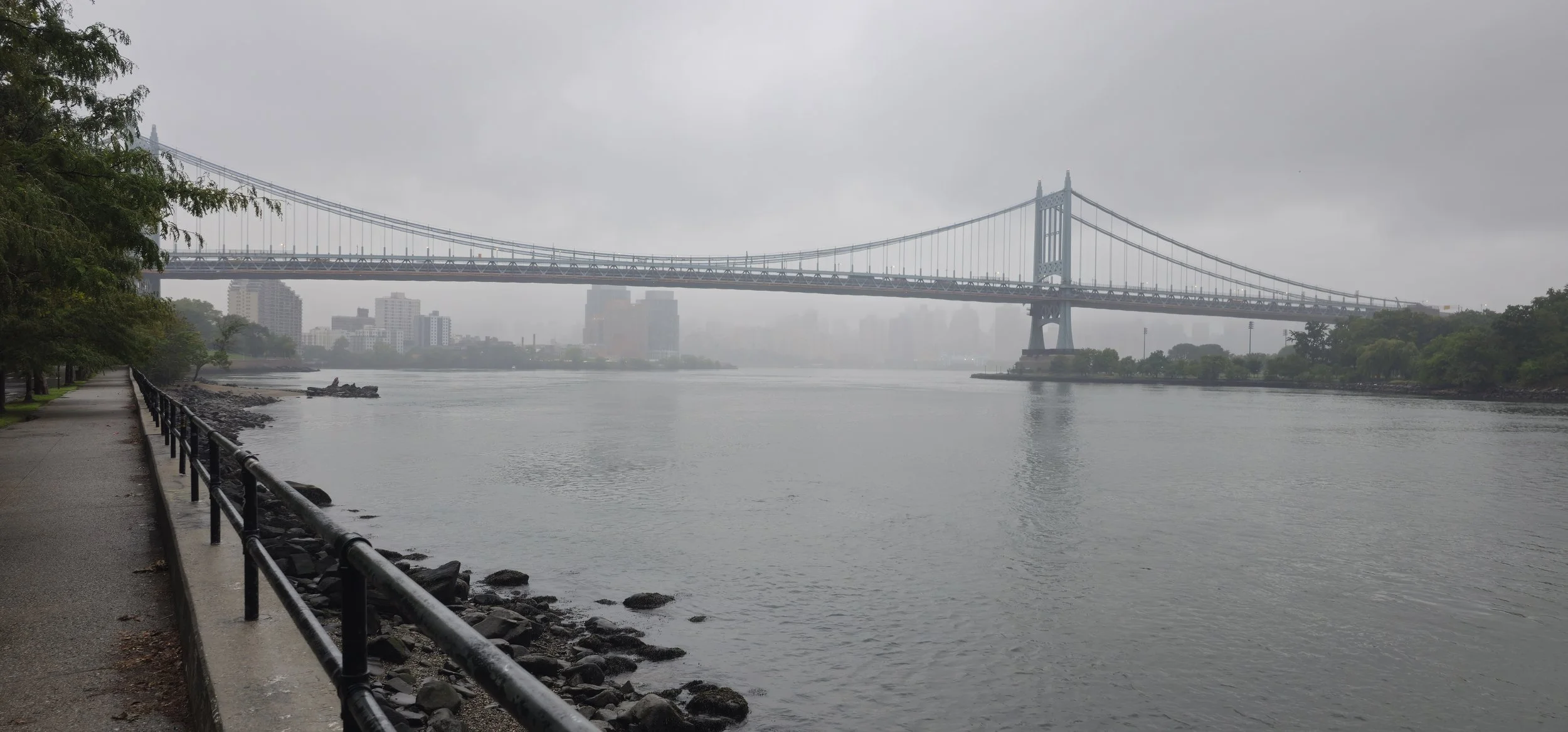
Walking Astoria #8
Essays and images exploring how societies shape mathematics and how mathematics shapes our world. A public notebook from my walks in Astoria, NYC, and beyond, as I research and write my book On the Origin of Mathematics: by Means of Social Selection.
—-
It was raining this morning. Not hard. A summer rain.
Yesterday, Astoria Park was full of people. Today, it’s almost empty.
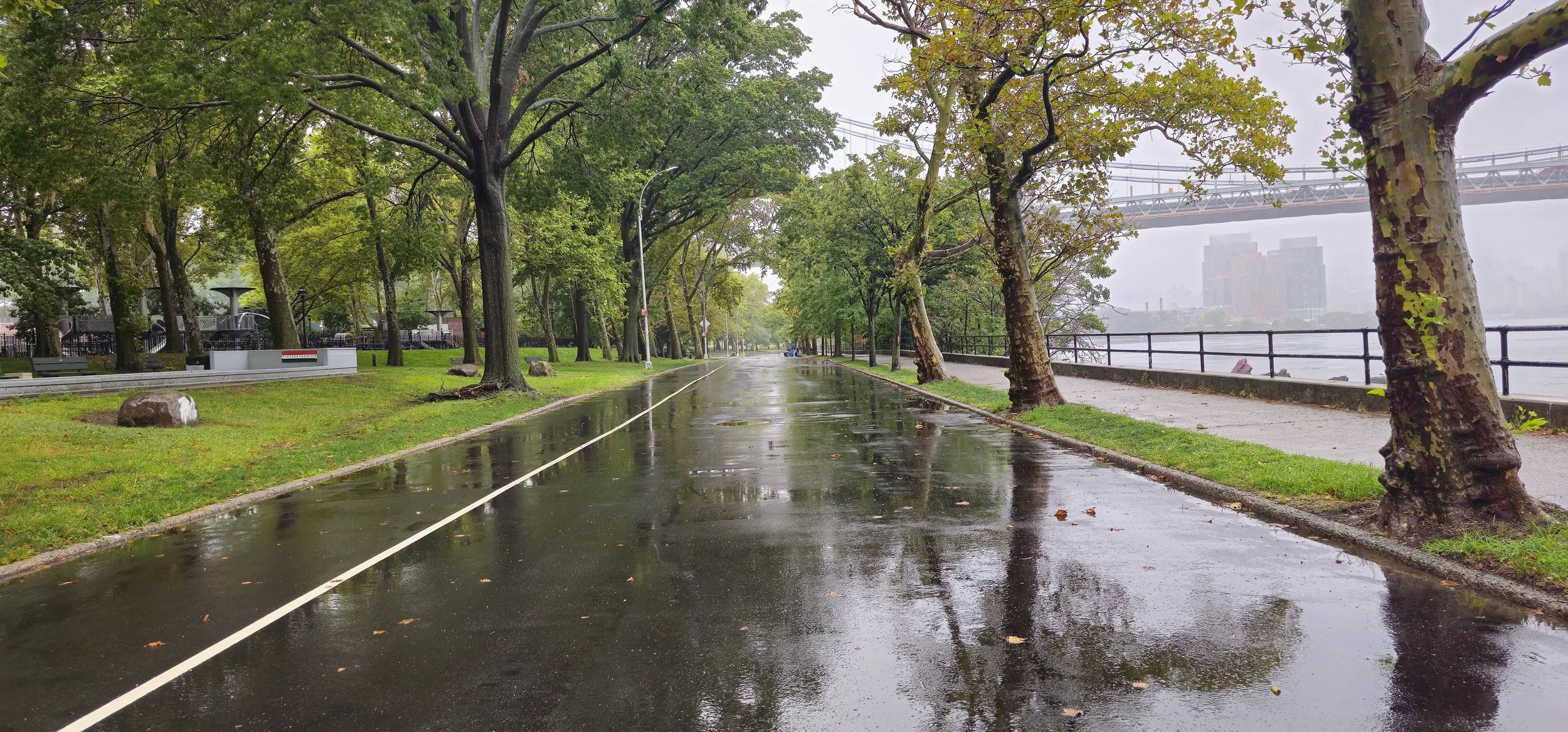
The Astorians who would usually have been in the park at this time of day decided to stay home.
Is this empty park still Astoria Park?
Yesterday I was looking at the desire path beside the stairs, the path made by mothers with strollers who could not use the steps. People had changed the park. They had created a route that was not in the plan.
But if people are removed, nothing of what I just said here makes any sense.
The part of Astoria Park that is called the “Great Lawn” was closed throughout the summer of 2025 for reconstruction.
Without people, was the Great Lawn the Great Lawn?
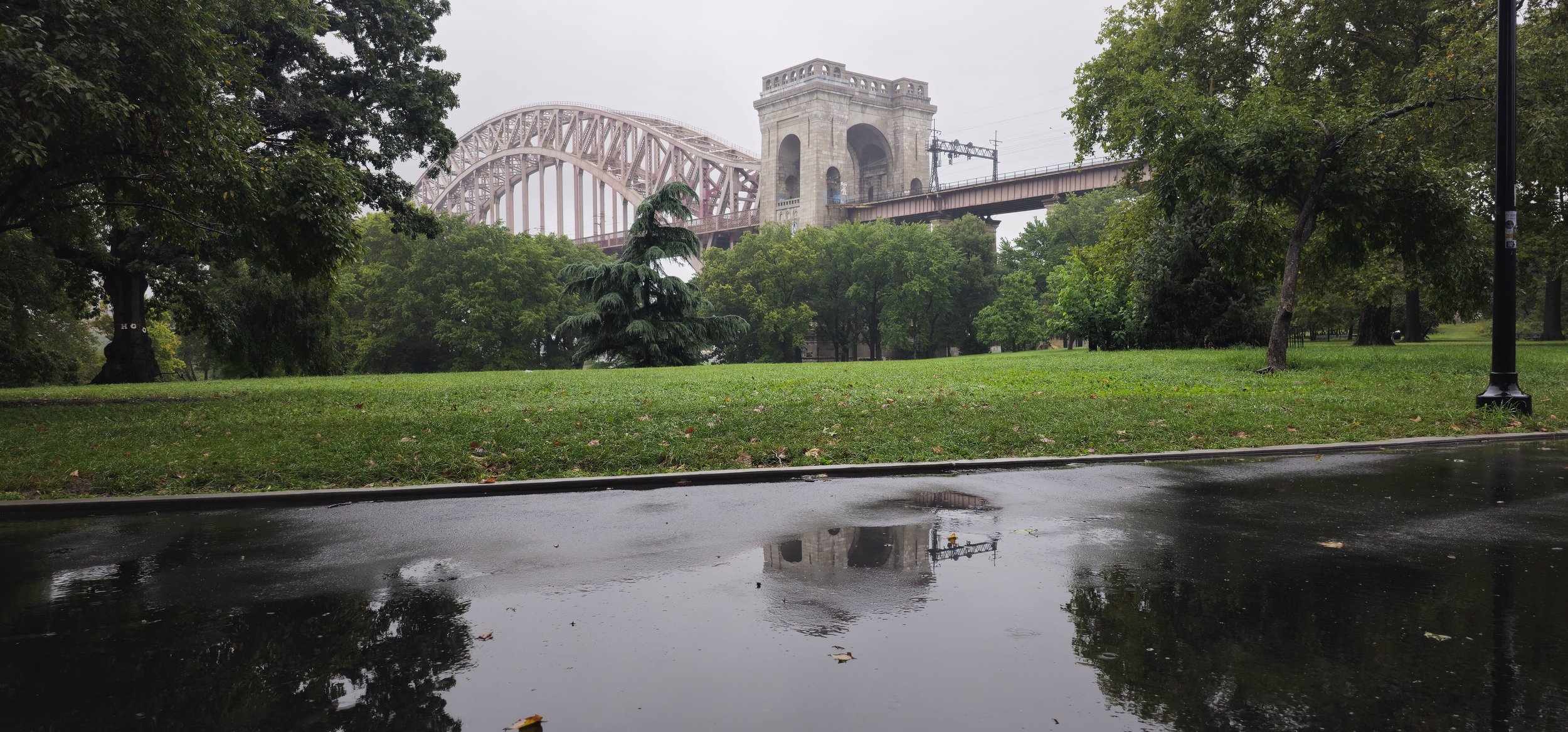
The Great Lawn
And this question brought to mind Pripyat, the industrial city in Ukraine built near the Chornobyl Nuclear Power Plant.
It was April 26, 1986, when reactor 4 of the Chornobyl Nuclear Power Plant exploded.
Back then, Ukraine was part of the Soviet Union.
The Soviet Union presented its nuclear power stations as achievements of Soviet engineering, harnessing nuclear power for peaceful purposes.
And 1986 was five years before the Soviet Union itself dissolved.
The Soviet authorities initially concealed and downplayed the extent of the disaster.
About 36 hours after the explosion, Pripyat was evacuated. A 30-kilometer Exclusion Zone was established around the plant, and about 200,000 people were eventually relocated because of the disaster.
Question: Is the empty industrial city of Pripyat still a city?
About 2,500 years ago, the Athenians answered a much more serious and consequential version of that question.
Herodotus, often called the father of History, tells us the following story:
In 480 BCE, Xerxes, the King of Kings of the Achaemenid Empire, was heading toward Athens with the Persian army.
The Athenians sent messengers to Delphi to consult the Pythia, the priestess of Apollo.
The Pythia told them, in terrifying terms, that Athens would be destroyed and that they should flee.
The messengers were so distraught by the prophecy that, following the advice of a man from Delphi, they approached the Pythia again as suppliants and asked for another prophecy.
Like we do with doctors when we don’t like their diagnosis.
The second prophecy was only slightly more helpful: Athens would be lost, but Zeus would grant Athena a “wooden wall” that would protect her people. And then came another line about “divine Salamis.”
Very clear. Thank you, Apollo.
The messengers returned to Athens with the second prophecy and presented it to the people.
And then something happened that I find more interesting than the prophecy itself:
The Athenians argued about it.
Some of the older Athenians thought the wooden wall meant an old wooden defense around the Acropolis. Others thought it meant the ships. The professional interpreters of prophecies thought the reference to Salamis was a warning that the Athenians would be destroyed there.
Then Themistocles, one of Athens’ leading politicians and military commanders, argued that they were reading the prophecy wrong. If the Athenians were to be destroyed at Salamis, why would Apollo call it “divine”?
Therefore, the victims at Salamis, he argued, would be the Persians.
The wooden wall was indeed the fleet.
Let’s think about this for a moment.
Apollo had spoken.
But the god’s words did not execute themselves.
Apollo did not hand Athens a policy. He gave them an ambiguous sentence. The sentence entered the human world, where people disagreed about what it meant.
One interpretation encountered another interpretation.
There was an agōn of opinions.
Themistocles made an argument, and the Athenians had to decide.
This was not secular democracy. Apollo was not being treated as a fictional character or as a metaphor. The Pythia had genuine religious authority for the Athenians.
But even divine authority did not eliminate Athenian judgment.
Yes, the god could speak.
But it was still the people who had to decide what to do.
And the people chose the ships.
The Athenians evacuated much of the population. Families were sent to Troezen, Aegina, and Salamis. Xerxes entered Athens. The Acropolis was taken and burned.
Athens was gone.
Or was it?
At Salamis, this question became explicit.
The Greek commanders were debating whether the fleet should stay and fight there or withdraw toward the Peloponnese. Themistocles argued for staying.
Adeimantus, the Corinthian commander, attacked him: Athens had been captured. Themistocles was now a man without a city. What right did a man with no polis have to speak in the council?
Themistocles answered that the Athenians still had a city and a country as long as they had two hundred fully manned ships.
And if the other Greeks refused to fight at Salamis, he threatened to put the Athenian families aboard and sail west to Siris in southern Italy.
The walls could burn.
The temples could burn.
The houses could burn.
But Athens could move.
Sixty-seven years later, during another Athenian disaster, this time in Sicily, Thucydides, often called the father of scientific history, reports Nicias, the Athenian politician and general, saying the sentence that contains the idea:
ἄνδρες γὰρ πόλις
Men are the polis.
Or, in the fuller sentence: men make the city, not walls or empty ships.
The two stories are not the same story.
Themistocles is speaking at Salamis in 480 BCE.
Nicias is speaking during the retreat from Syracuse in 413 BCE.
But they carry the same idea:
A polis is not its infrastructure.
It is its people.
We the people are the city.
And I know what you think: the Athenians literally said, “men are the city.”
“We the people” sounds like everybody, but “men” didn’t even mean “all men.” It meant the adult male citizens who could participate politically: roughly 10 to 20 percent of the population, depending on the period and the estimate. Women were excluded from political participation, and slaves, metics, and boys not yet enrolled as adult citizens were also excluded.
Also, the Athenians had not separated religion and government in anything like the modern American sense.
The First Amendment prevents Congress from establishing a religion and protects its free exercise.
A citizen can enter political debate with a theological argument.
A Christian can say that Christianity requires one thing, a Jew another, a Muslim another. An atheist can reject the premise entirely.
All of those claims can enter the argument.
But none wins because it allegedly came from God.
No priest gets an extra constitutional vote because he claims to know what God wants.
And then the Constitution does something before it has even reached Article I.
It tells us who is speaking:
“We the People.”
Not the king.
Not the church.
Not the states, even.
We the People “ordain and establish” the Constitution.
But there is an obvious problem hiding inside those three beautiful words.
Who is “we”?
In 1787, the people living under the new Constitution did not possess equal political standing.
Slavery still existed.
Women did not have equal political rights.
The electorate varied from state to state.
But the Constitution also contained Article V, a mechanism for changing the Constitution itself.
The amendment mechanism.
And what happened later is, for me, the most extraordinary part of the democratic experiment of the United States of America:
The Thirteenth Amendment abolished slavery.
The Fourteenth Amendment expanded and constitutionalized the meaning of American citizenship itself, explicitly including anyone “born or naturalized in the United States.”
The Fifteenth Amendment prohibited denying the vote on account of race, color, or previous condition of servitude.
The Nineteenth Amendment prohibited denying the vote on account of sex.
The Twenty-fourth Amendment prohibited poll taxes in federal elections.
The Twenty-sixth Amendment brought the voting age down to eighteen.
The history is much messier than that list, of course, and none of those changes happened because the Constitution politely corrected itself one afternoon.
People fought for every expansion.
And this is why the “we” did not remain frozen in 1787.
Article V made the Constitution reopenable.
And it was the people who forced the reopening.
And the “we” expanded.
Maybe that is one of democracy’s most important properties.
Not that democracy cannot be wrong.
It can be spectacularly wrong.
But a democratic closure does not have to be final.
Even the boundary around the people who are included in “we” can become an object of argument.
We the people are the city.
And, today, on a rainy summer Monday in Astoria, we the people decided to stay home until the sky reopened.