Walking Astoria #6
Essays and images exploring how societies shape mathematics and how mathematics shapes our world. A public notebook from my walks in Astoria, NYC, and beyond, as I research and write my book On the Origin of Mathematics: by Means of Social Selection.
—-
I came to Astoria Park earlier than I usually do.
The sun was still coming up through the trees.
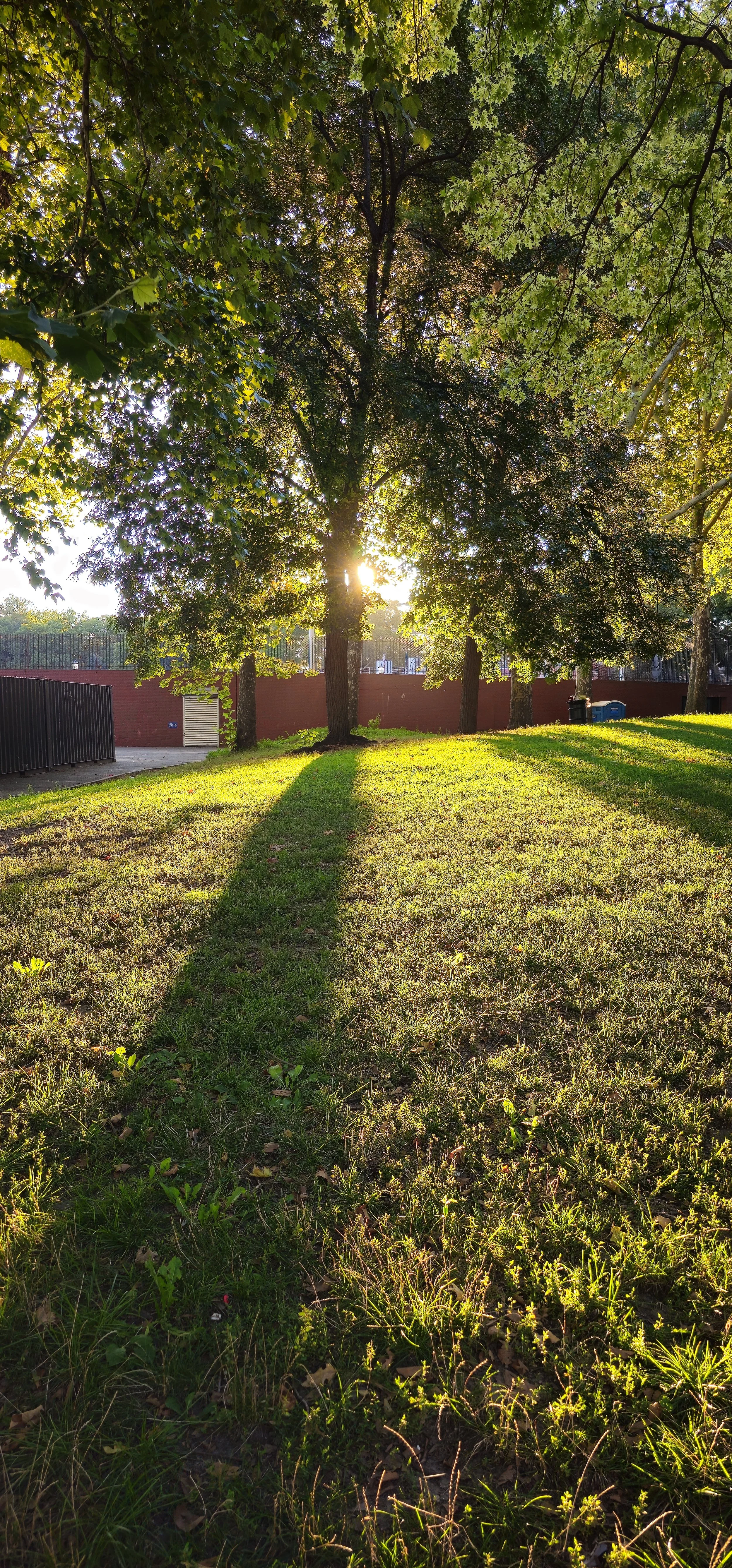
Sunrise in Astoria Park
Yesterday I was thinking about domestication.
Wolves becoming dogs.
Plants becoming crops.
Land becoming fields.
Conflict becoming law.
About civilization being the domestication of humans.
But.
Every child is born into a civilization he or she did not make.
The language is already here. The roads are here. The buildings, the numbers, the calendar, the laws, the stories, the gods, the Constitution, Mathematics, Everything.
The child arrives into a conversation that has been going on for thousands of years.
How does this child take part in this conversation?
The answer is education.
Not school.
Not yet.
For all of human history, at least before the cities, education was taking place inside life itself.
A child learned how to hunt by going hunting, how to gather by gathering, and how to make a tool by watching someone make it.
By trying and failing. And trying again.
Stories the elders told around the fire about the ancestors were the memory.
Elders shared their past experiences. Other children shared their own ways, their own techniques.
The world itself was the learning environment.
Everyday life was the curriculum.
The others were the teachers.
We domesticated plants and animals, and we settled. We accumulated food as surplus. We built houses, walls, temples, roads, and irrigation systems.
We domesticated space: This is my field. That is yours. This is a road. This is a boundary. This is a city.
Herodotus, the ancient Greek historian and geographer, considered the father of History, says that geometry originated in Egypt, where they repeatedly measured the land each time the Nile flooded and charted the boundaries of their fields.
When humans began domesticating the earth, measurement became essential. But the word we use is Greek: geometry literally means in Greek “measuring the earth.” Because the Greeks turned practical geometry into a system. Demanding a public demonstration: a proof that has to survive scrutiny.
But I digress. Mathematics and proof are for another walk.
So, when humans wanted to know when to plant, when seasons would change, how to navigate, where they were, they learned to read the night sky.
And this way we domesticated time also: Plant now. Harvest then. Meet here. Pay tax on that day. Celebrate this festival when that star appears.
The Mesopotamians turned numbers, time, and observing the night sky into a technology.
It was Babylonian astronomers who observed the celestial cycles for generations, and they calculated using a sexagesimal system: base 60. We have inherited that ancient system.
Have you ever wondered why, when we measure time or make astronomical observations, we use base 60 for calculations? Have you ever wondered why there are sixty seconds in a minute? Sixty minutes in an hour? Twelve hours of daylight and twelve hours of night? Why the zodiac has twelve signs? Why there are three hundred and sixty degrees in a circle?
We inherited those from the Greeks, who inherited them from the Egyptians, who inherited them from the Babylonians. Who inherited them from the Sumerians.
Of course, the actual history is not so clear-cut as I describe it here. These civilizations were in conversation throughout the ages. And the influences went both ways.
And it was exactly because of the new needs of city life that we created calendars, numbers, accounts, taxes, writing, geometry, and astronomy.
The world humans had constructed was demanding new kinds of knowledge.
And these new kinds of knowledge became distributed.
The farmer knew something the builder did not. The builder knew something the sailor did not. The sailor knew something the physician did not. The physician knew something the scribe did not. The scribe knew something the metalworker did not. And so on.
No single person alone could hold all the civilization's knowledge in their head anymore.
The knowledge necessary for society to survive existed among people. Between all the people living in the same city.
So now, the society has a new problem: how do you transmit a distributed kind of knowledge to the next generation?
I looked at the Hell Gate Bridge.

The Hell Gate Bridge under the morning light
Nobody is born knowing how to build this bridge.
You need geometry, metallurgy, statics, materials, design, engineering, surveying, and organization.
Thousands of years of accumulated human knowledge are sitting above the East River translated into steel.
The engineers did not rediscover all of them from scratch. They inherited them.
That is what education does.
And I don’t necessarily mean formal education.
Actually, the engineer who designed the Hell Gate Bridge, Gustav Lindenthal, didn’t have an engineering degree. He was mostly self-taught.
The bridge I am using as an image of inherited knowledge was designed by someone whose own education came partly from attending some classes at polytechnical schools in the Austrian Empire, where he was born, and partly from work, apprenticeship, and observation. Not from formal schooling.
Education, formal, informal, or social, allows the dead to teach the living. Transforms people into something more than the collection of individuals: A society. A civilization.
And as cities grew larger and knowledge became more specialized, civilizations began building places where knowledge could be passed on to the new generation of citizens. They designed places for knowledge inheritance:
Athens with Plato’s Academy and Aristotle’s Lyceum, later, Epicurus’s Garden and the Stoics at the Stoa. Different schools, different answers, different worldviews, different ideas about almost everything that mattered to the Greeks.
The Mouseion and the Library of Alexandria, trying something never attempted before: collect all the knowledge of the then-known world in one place: Hellenistic and Greek, Egyptian, Babylonian and Assyrian, Jewish, Persian, and Indian.
Baghdad became another great center for translation, mathematics, and scientific innovation with the House of Wisdom. There you could hear Greek, Hebrew, Syriac, Persian, Indian, and Arabic. Translators, mathematicians, physicians, and astronomers discussing. Knowledge crossing languages, religions, and philosophical traditions: Muslim, Nestorian and Syriac Christians, Jewish scholars, Zoroastrians, Indian and Greek philosophers.
Then China gives us an independent version of the same phenomenon.
The Hundred Schools of Thought: Confucians, Mohists, Daoists, Legalists, and scholars from other traditions arguing about government, ethics, human nature, language, war, and order. Later, Buddhism arrived from India and generated a whole new set of Chinese schools and syntheses: The Five Houses of Chan, Pure Land, Tiantai, and Huayan.
The more complicated the human world becomes, the more the civilization needs memory outside the individual:
Texts. Schools. Libraries. Teachers. Institutions.
Education becomes the bridge across generations.
John Dewey understood this beautifully. He wrote Democracy and Education in 1916 while he was at Columbia University here in New York. For Dewey, education is not something added to a society after the important things have happened. It is the mechanism through which a society continues to exist after the people alive today are gone.
But knowledge is not transferred only under a democracy.
A monarchy can teach mathematics. An empire can train engineers. A dictatorship can produce doctors. You can memorize a constitution in a classroom where nobody is allowed to disagree with the instructor.
But Dewey said it best: democracy is more than a form of government. It is a mode of associated living.
Which means that democracy cannot be taught. It can only be practiced.
And then I arrived at the skate park.
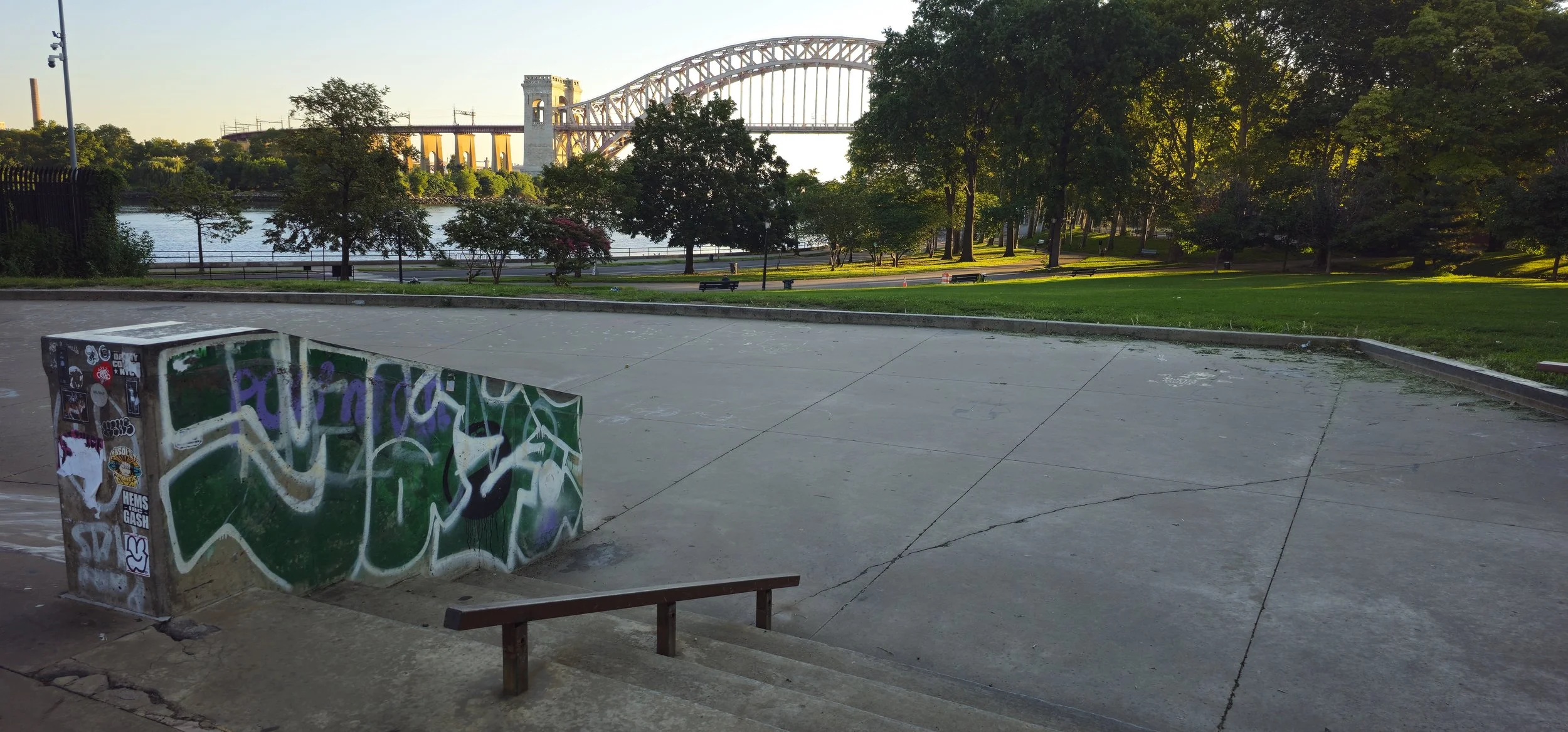
The skate park, too early for the teenagers
Normally, it is full of kids skating.
One tries something. Another watches. Someone falls down. Someone shows somebody else how to do it. Somebody copies. Somebody changes it. Somebody is trying something new.
Nobody has prepared the “Introduction to Falling Off a Skateboard” PowerPoint.
They learn skateboarding by skateboarding.
So, how do you learn democracy?
A child cannot vote in a federal election, cannot serve on a jury, and cannot run for office.
And then, at eighteen, we suddenly expect them to know how to function as political citizens?
It is true that we do teach civics. And rightly so. We teach the Constitution. As we should. Language, history, mathematics, science, literature. Of course.
But democracy is not something you learn by reading. It is something you learn by doing it. By participating.
So, the education I have in mind looks different than what what exists today.
It goes something like this:
A small group of students has a real problem to solve.
One student makes a claim.
Another disagrees.
They give reasons.
Evidence.
They listen.
They reply.
And then there is a third position:
The other students. The group itself.
The group judges.
Not necessarily to discover the truth. They decide what they will accept for now so they can move on.
When I hear the word “truth,” I only think of mathematics.
When something has been proven true inside a mathematical system, it will remain true until the end of time. Other human affairs are not so accommodating or clear-cut.
Even in science, something once considered necessary has been proven false when new evidence, results, or observations have become available.
The luminiferous ether was once thought necessary for electromagnetic waves to propagate. Until Einstein famously said, “Hold my beer.”
And don’t get me started on religions, ideologies, and other dogmas. Each has its own eternal, irrefutable, and unconditional truth.
So, the group of students, after hearing the dialectic between the opposing opinions, judges. They agree on a closure. They act on it. They see what happens. And, if necessary, they will reopen it in the future.
And now diversity becomes essential.
Because if everybody in the group has the same history, the same assumptions, the same experience, the same answers, then there is no dialectic.
A dialectic needs difference. Tension. Opposing views.
I make a claim. You see something I do not. You oppose it. I have to explain why I think my claim is correct. You have to explain why you think my claim is absurd. Maybe one of us changes. Maybe both of us change. Maybe the group finds a possibility neither of us had thought of.
It is difference that creates variation.
And New York is an interesting case.
Not because it is a “melting pot.” That implies assimilation. Becoming all homogeneous. Having the same views. The same opinions.
And it’s not interesting just because people from different parts of the world happen to live near one another.
New York is interesting because New Yorkers work together. Buy from one another. Eat each other’s cuisine. Teach one another’s children. Argue. Translate. Open restaurants together. Start businesses together. Vote. They all complain about parking. In more than 800 languages. And we all get crammed like sardines on the 1, the 7, or the N train.
The train may be the most successful form of cultural integration NYC has to offer.
New York is among the cities that appear in my book:
Uruk, Memphis, Byblos, Thebes, Babylon, Hattusa, Ugarit, Kalhu, Nineveh, Miletus, Athens, Alexandria, Rome, Chang’an, Baghdad, Florence, Amsterdam, London, Paris, Philadelphia, Berlin, New York.
Not all ports, but junctions.
Places where routes cross.
Goods cross.
Languages cross.
People cross.
Ideas cross.
Arguments cross.
Places where every argument is bumping into a counterargument.
And let me end this walk with two intriguing observations.
Aristotle is so closely associated with Athens that it is easy to forget that he was not an Athenian.
He was born in Stagira, in northern Greece.
In ancient Athenian terminology, he was a metic.
In today’s New York vocabulary, Aristotle was a transplant.
And then there is Thales.
If you ask who was the most prominent among the Seven Sages of ancient Greece, the answer is Thales.
If you ask who is considered the father of natural philosophy, the answer is Thales.
If you ask who is considered the first mathematician, the answer is Thales.
What if I told you that the first mathematician, the father of natural philosophy, and the most prominent among the Seven Sages of ancient Greece, was from Miletus, an Ionian Greek city on the coast of Asia Minor? A trading city sitting exactly where worlds cross?
Then Herodotus makes the story even more interesting. He describes Thales as Phoenician by descent. A much later ancient tradition goes further, claiming that Thales himself came from Phoenicia and was admitted to Milesian citizenship. Other ancient writers disagree os course, but still.
In today’s language, the story of Thales looks remarkably like the story of an immigrant family at a cultural crossroads.
Aristotle was a transplant.
And Thales could be described as an immigrant.
Maybe civilizations become more fertile, more productive, more democratic, and certainly more interesting at the junctions.
The intersections.
The crossroads.
The crossroads of languages, worldviews, and cultures.