Walking Astoria #3
Essays and images exploring how societies shape mathematics and how mathematics shapes our world. A public notebook from my walks in Astoria, NYC, and beyond, as I research and write my book On the Origin of Mathematics: by Means of Social Selection.
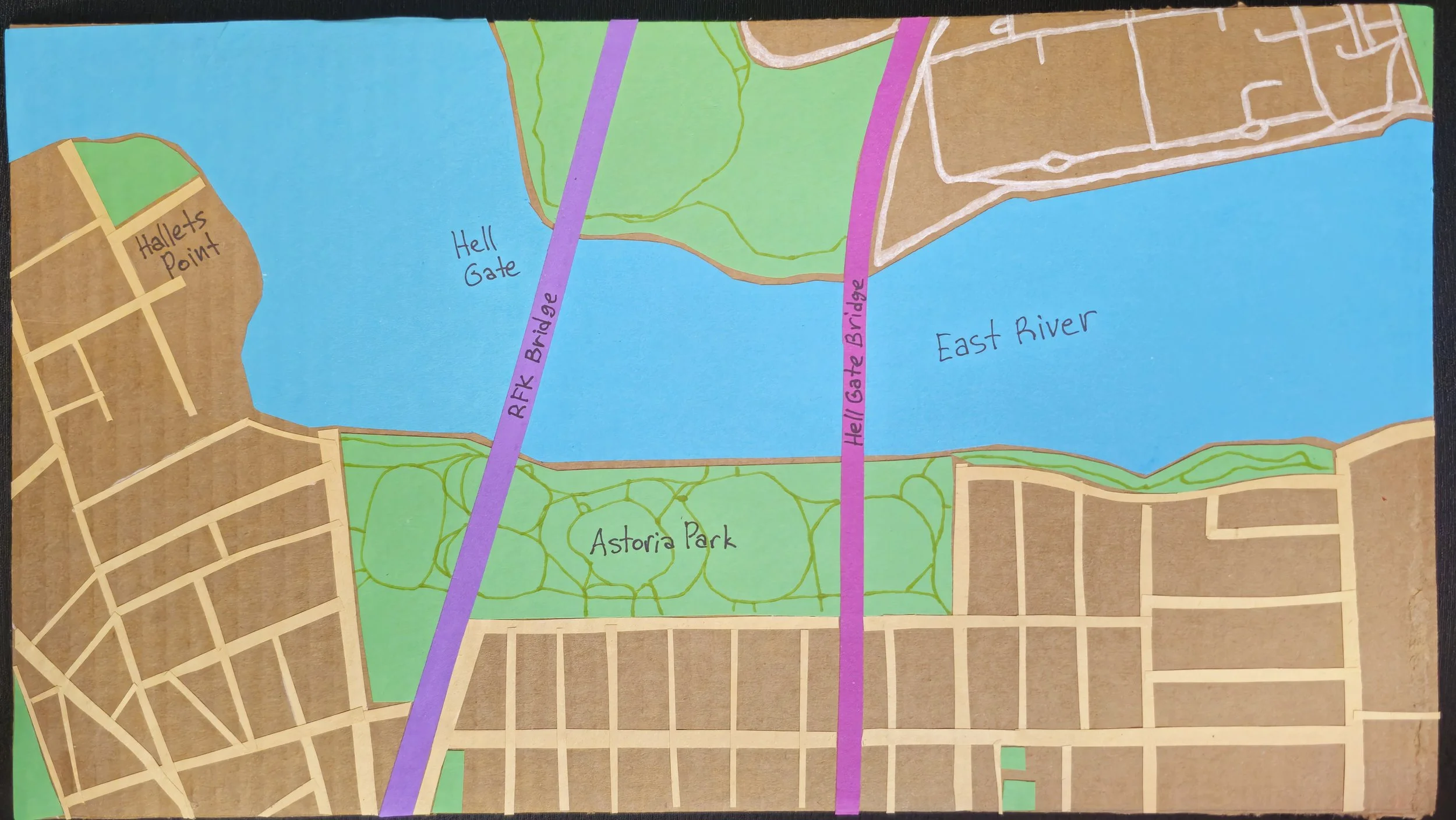
My map of Astoria Park and the East River
Today, as I was walking along the East River, the river itself drew my attention.
The current was crazy.
Parts of the water seemed to be moving in different directions at the same time. There were currents, countercurrents, eddies, circles forming and disappearing.
And that reminded me that the East River is not really a river.
It’s a tidal strait.
It connects New York Harbor with Long Island Sound, and the water reverses direction with the tides.
So, after yesterday’s pebbles that turned out to be glass, and the Manhattan skyline that turned out partly to be Hallets Point, today the East River turned out not to be a river.
Of course.
And the part of the East River I was looking at has another name: Hell Gate.
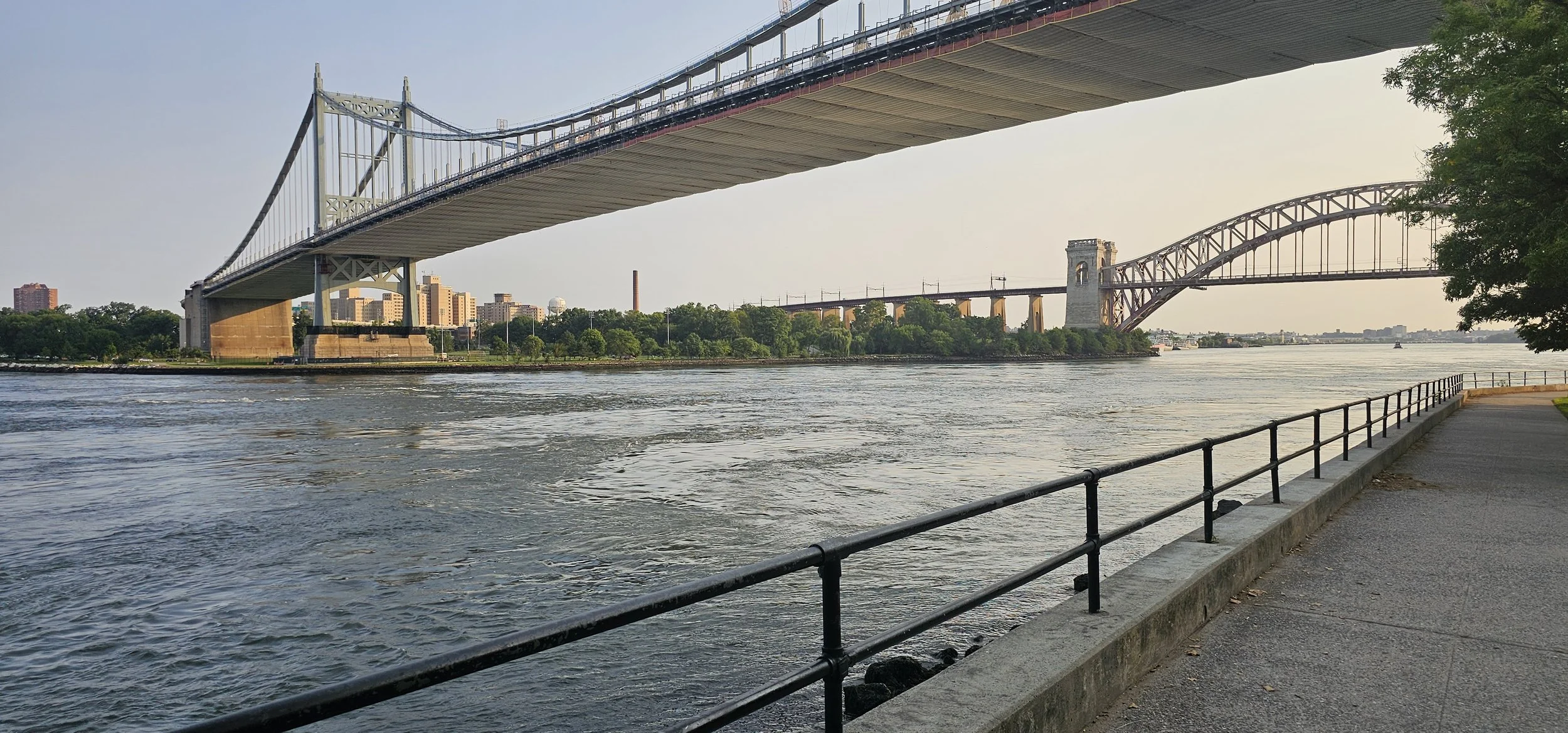
Hell Gate, between Astoria Park and Wards Island.
Hell Gate is the narrow section of the strait between Astoria and Wards Island, where the tidal currents have historically been so strong, and the underwater rocks so dangerous, that navigation was extremely difficult. In the nineteenth century, the Army Corps of Engineers spent decades blasting away rocks to make the passage safer.
And above Hell Gate is the RFK Bridge. Except everybody around here calls it the Triborough Bridge.
It opened as the Triborough Bridge, but it was officially renamed the Robert F. Kennedy Bridge in 2008.
So, what should I call it? The RFK Bridge? Or the Triborough Bridge?
And which one is the real name?
And my mind leaped to the electron.
Is it a particle? Is it a wave?
Physics spent a long time trying to answer questions like that using categories that had worked perfectly well before. And then quantum mechanics complicated the story.
Depending on how we interact with it, an electron can produce particle-like events or wave-like interference.
So which one is it really?
Maybe the problem is the question.
Maybe “particle” and “wave” are maps too.
Useful closures.
Ways of holding something long enough to understand it, predict something, and do something.
But perhaps neither one, by itself, tells us what the electron ultimately is.
I looked again at the water.
There was no obvious answer there either.
The physics that studies the motion of fluids is fluid dynamics. And what I was watching on the surface was turbulence.
I initially thought: maybe this is one of those places where physics fails because turbulence is not deterministic.
Wrong again.
Turbulence is chaotic, but classical chaos can be completely deterministic.
That is actually stranger.
The equations can be deterministic, the rules can be deterministic, but still extremely small differences in the initial conditions can eventually produce dramatically different outcomes.
The system indeed follows rules, but prediction becomes extraordinarily difficult.
We know the rules and still cannot necessarily tell exactly what the water in front of me will do.
There is something I like about that.
Or maybe something that bothers me.
Because yesterday I was talking about being wrong.
The pebble was glass.
Manhattan was Old Astoria.
Today the river is not a river.
The RFK Bridge and the Triborough Bridge are the same bridge.
The electron refuses to behave like either of the categories we want to put it into.
And the water is following deterministic physical laws while looking completely confused about where it wants to go.
And I kept walking.
Away from Manhattan, along the East River. Which is not a river.
I kept walking.
At some point, if you keep doing this, you can start doubting everything you know.
And that’s why Socrates said: “The one thing I know is that I know nothing.”
Wait. Wrong again. Socrates didn’t say that.
This is a popular paraphrase of what’s in Plato’s Apology. Socrates’s point is more interesting. He said that, contrary to people who don’t know and think they know, for what he does not know, he does not think that he knows.
That is a much harder discipline.
Then René Descartes went much further:
Doubt the senses.
Doubt the world.
Doubt whether you are awake.
Doubt even mathematics.
Because an evil demon might be deceiving you.
Keep doubting until you reach something that the act of doubting itself cannot destroy.
I am doubting. Therefore, for sure, there must be a subject that is doing the doubting.
I think, therefore I exist as a doubting subject: I think, therefore I am.
And there I remembered another quote.
Which I thought was Nietzsche’s.
And it wasn’t.
Wrong again.
It was the French writer, Diane de Beausacq, who wrote: “Doubt poisons everything and kills nothing.”
That is the problem: If I keep doubting everything, eventually, I will not be able to do anything.
Is this a pebble?
Maybe.
Is that Manhattan?
Partly.
Is this the East River?
Yes. Except it is not a river.
Is that the RFK Bridge?
Yes. But it’s also the Triborough Bridge.
Is an electron a particle?
Yes.
Is it a wave?
Also yes.
At some point, I still have to walk home.
A doctor still has to make a diagnosis.
A jury still has to reach a verdict.
A scientist still has to publish a conclusion.
A historian still has to tell a story.
A society still has to decide what to do.
So what do we do with an open world if every description of it can be questioned?
The English philosopher Hilary Lawson gives me a word that I have found increasingly important for what I am trying to understand:
Closure.
In his book, “Closure: A Story of Everything,” Lawson asks us to think of the world as open.
We make sense of that openness by closing it.
We hold the world as something.
This is a river.
This is a bridge.
This is a pebble.
This is Manhattan.
This is a particle.
This is a number.
This is a fact.
A closure does not have to be the final description of what is there. It’s enough to be one possible description.
The closure allows us to engage with what is there.
Allows us to act.
Calling this the East River works extraordinarily well.
If someone tells me, “Meet me in Astoria Park by the East River,” I am not going to reply, “Well, technically, what you call a river is actually a tidal strait. It connects New York Harbor with Long Island Sound, and the water reverses direction with the tides.”
If someone tells me, “Meet me in Astoria Park by the East River,” I know where to go.
The closure works.
Until it doesn’t.
Until a different question requires me to open it again.
If I want to understand why the water reverses direction, “river” becomes a bad closure.
I have to reopen it.
And use “tidal strait.”
Lawson describes closure through sensation, thought, and language.
But what I am interested in is what happens when the closure is not mine.
When it becomes ours.
Or, more precisely, when my closure encounters yours.
I say something.
You say the opposite.
Now what?
Maybe this is what I have been circling around when I keep returning to Athens.
Democracy.
Theatre.
Mathematics.
Philosophy.
Medicine.
History.
The jury.
Maybe what is common among them is not simply that they all appeared or flourished in the same place at the same time.
My hypothesis is that in Athens, closures became negotiable.
They became public, and they were negotiated. Like produce, pottery, and crafts, which were traded and negotiated at the Agora.
One citizen makes a claim.
Another one can oppose it.
And then there is a third party:
The chorus.
The audience.
The jury.
The people who hear the argument, the people who decide: The adjudicating citizens.
The “Ekklesia,” the called-out people: the assembly.
Closure is no longer simply something I hold in my head.
It becomes something that has to survive contact with other people.
And then, somehow, a closure has to happen.
For now.
The jury votes.
The audience judges.
The mathematical argument is accepted.
The diagnosis is made.
The law is passed.
The story is written.
We act.
But the channel cannot close forever, because there may be another argument. Another observation. Another piece of evidence. Another person. Another generation. Another closure.
Yesterday I said I would include my hypotheses in my book, knowing that I might be wrong.
Today I think I have to add something.
Knowing that I might be wrong does not release me from the obligation to decide what I think.
Otherwise, there is no book.
There is no science.
There is no history.
There is no democracy.
There is just doubt.
And doubt poisons everything and kills nothing.
Yes, the East River is not a river.
But tomorrow morning I will walk by the East River again.