Walking Astoria #4
Essays and images exploring how societies shape mathematics and how mathematics shapes our world. A public notebook from my walks in Astoria, NYC, and beyond, as I research and write my book On the Origin of Mathematics: by Means of Social Selection.
Today, on my way to Astoria Park, they were shooting a movie.
Film production trucks were parked beside Astoria Park.

Film production trucks parked beside Astoria Park.
And my mind went to Aristotle.
Two thousand three hundred years after Aristotle wrote it, the Poetics is still taught in theatre and film courses today.
Aristotle says that Aeschylus was the first to increase the number of actors from one to two.
One actor can speak.
With two actors, one can answer the other.
One can contradict the other.
Something happens between them:
Conflict.
Again and again in tragedy, a human being finds himself or herself between incompatible claims, obligations, loyalties, laws.
Agamemnon.
Clytemnestra.
Orestes.
Electra.
Oedipus.
Creon.
Antigone.
Do this, and something terrible follows.
Do the opposite, and something terrible follows too.
Tragedy does not make the contradiction disappear. It puts it on stage.
In public.
And the great tragedians weren’t “producing” tragedies. They were not presenting shows. The great poets were teaching tragedies.
And that teaching did not stop with the chorus.
And much of that audience was the citizen body.
Citizens weren’t there only to enjoy the show. They weren’t there only to escape, to forget their everyday problems, to have fun.
They were there to learn. To think on the issues concerning their city. Their polis.
“Didaskalia” is the word. And it means the act of teaching.
And “didaskein” is the verb. Which meant to teach the chorus the tragedy.
Aristophanes wrote a comedy called The Frogs. In The Frogs, the great tragedians are dead. And Dionysus, the god of theatre himself, goes down to the underworld to bring a poet back, because the city needs one.
And down there, Aeschylus and Euripides are competing for the chair of tragedy. They argue. Line by line. And Dionysus has to judge between them. Find the best of the two.
Two poets in conflict. And a third who decides.
And in the middle of this contest, Aeschylus says it: little boys have a teacher to instruct them. Grown men have the poets.
The poets are the teachers of adults.
The Frogs is a comedy where the theatre watches the theatre judging itself.
Performed, of course, in a competition.
Which was judged.
And who was the chorus?
Citizens. Recruited and trained under the responsibility of the “chorēgos,” a wealthy citizen who financed it as a public service to the polis.
And tragedies were part of a dramatic competition. Judged by citizens.
One judge from each of the ten tribes of the city. The tribes that Cleisthenes had created when he redrew the map of Attica.
Their names were drawn from sealed urns at the start of the festival. At the end, each judge cast a ballot. And then chance intervened again: not every ballot necessarily counted. The exact counting procedure is disputed, but the use of lots made bribery and intimidation much harder.
Can you see what they were trying to do?
You could bribe a judge and still fail.
Chance limited anyone’s ability to know in advance which votes would determine the result.
They designed the judging to make it much harder to buy.
So theatre itself was an agōn: a public competition, where there was judgment by the citizens.
The poet competed with another poet.
On stage, one position confronted another. Two actors are publicly staking opposing claims.
The chorus listened, reacted, feared, advised, questioned, and sometimes changed its position.
And beyond the chorus, thousands of citizens were watching. In a way, the chorus could become a civic voice. Not necessarily the citizens. Not necessarily a common opinion. A collective voice inside the conflict.
Judging.
Not necessarily agreeing.
And the words themselves remember what all of this was.
The building is the “theatron”: the seeing place. From the verb “theasthai,” to watch, to behold.
The spectator is the “theatēs”: the watcher.
And there was one more watcher: when a Greek city wanted to attend one of the great festivals or consult the Oracle at Delphi, it sent an official witness. On behalf of the whole city.
That man was called a “theorōs.”
And what he was doing there, watching for his city, was called “theoria.”
Theoria.
Theory.
Yes. That is where the word comes from: Before theōria became philosophy’s word for contemplation, it belonged to this world of seeing: sacred journeys, festivals, oracles, and civic observers watching on behalf of their communities.
The word theory began as watching.
I find it difficult not to see something political there.
Not political as in political theatre, in the sense of propaganda.
Political in a more fundamental and meaningful sense.
The word “politics” is Greek and comes from “polis,” the city. But also the political community.
And the word “citizen” in Greek is “polites.” In his book “Politika,” Aristotle calls the human being “zōon politikon”: the animal whose life is bound up with the polis. We often translate this as “political animal” or “social animal,” but the Greek is more vivid to me. A human being is understood in relation to a shared public world, to the polis and its affairs.
To understand this more vividly, the Greek word “idiōtēs” meant a private person: someone acting in a private rather than public or official capacity. Guess which English word eventually descended from it.
So, in that sense, tragedy was politics. It was about the affairs of the polis. And the themes of tragedy were existential and social: the relationship between the gods’ laws and human law, war, the common fate that connects all humans, and the fact that, independently of the circumstances, we have to decide.
A polis was watching a conflict taking place in front of it.
A polis watches people make choices and then watches the consequences of those choices.
A polis watching itself.

Everyday Astorians simply walking, jogging, sitting, enjoying their thoughts.
And my thoughts reminded me of Cornelius Castoriadis.
Castoriadis, in his book, “The Imaginary Institution of Society,” makes a distinction which is central to what I am trying to understand: heteronomy and autonomy.
Every society creates institutions, laws, meanings, ways of living.
But in a heteronomous society, according to Castoriadis, society does not recognize itself as the source of those institutions.
The laws came from God.
From the gods.
From the ancestors.
From the Emperor
From the King.
From the Pharaoh.
From nature.
From history.
They are given.
They are not ours to question.
Autonomy begins when a society realizes something revolutionary:
“We made this.”
“And if we made it, we can question it.”
“We can change it.”
Castoriadis saw the Greek polis, and especially democratic Athens, as one of the great historical ruptures in which this happened.
The citizens legislate.
They judge.
They change their laws.
They question what is just.
And philosophy turns inherited answers into questions.
What is true? What is virtue?
This is Castoriadis.
But I want to go further.
And from here on I am stating my own hypothesis:
Athens became a self-reflective society.
A responsive society.
And here I want to risk a stronger hypothesis:
Athens may be the earliest society we can document clearly institutionalizing self-reflection in this particular way.
A society that could look at institutions it had inherited or created and say: “This is ours, if it is not working, we can change it.”
A society that could receive information from its social world, from its natural world, from the consequences of its own decisions, and change course.
And I can already hear the objection.
Other civilizations examined themselves too.
The Hebrew prophets stood in front of kings and told Israel exactly what was wrong with it. Generation after generation. That is social criticism. And it was institutionalized.
China, later, created officials whose duty was to criticize the emperor.
And so no. Athens did not invent self-criticism.
But look at the limitation.
The prophet criticizes the people under a covenant represented as divinely grounded, not as legislation authored and amendable by a citizen body. He calls them back to the covenant. He does not ask the people to legislate a new one.
The remonstrating official could rebuke the emperor, sometimes at enormous personal risk. But he did so within an imperial order. He did not speak for a citizen body institutionally empowered to rewrite the constitutional basis of sovereignty.
The criticism could reach the ruler. What it did not create was popular sovereignty.
What Athens institutionalized was different: procedures by which a society that knows it is the author of its own laws can collectively revise them.
And, in a very particular and broader sense of the word, this makes Athens a “scientific” society.
Not because everybody was a scientist.
Not because every Athenian decision was rational. Obviously not. The Athenians voted and gave the death penalty to Socrates of all people.
And I am not going to pretend that this is a detail.
The society I am calling self-examining executed its most famous self-examiner. In a formal trial. With a jury of citizens. By majority vote. And the decision was final.
But the laws stayed open. And the arguing did not stop.
For Socrates, the verdict was final. For the polis, the argument was not.
Later Greeks told stories that the Athenians regretted it. A statue. Punished accusers. Historians doubt these stories. My point does not need them.
The trial of Socrates deserves its own walk. I owe it one.
Athens became a scientific civilization, in the sense that the civilization itself began to do something that science does.
Make a closure,
act on it,
observe what happens,
question it,
reopen it,
and change it.
Which becomes a new closure.
We act on that.
And we observe what happens.
And so on.
And let me go even further with my hypothesis.
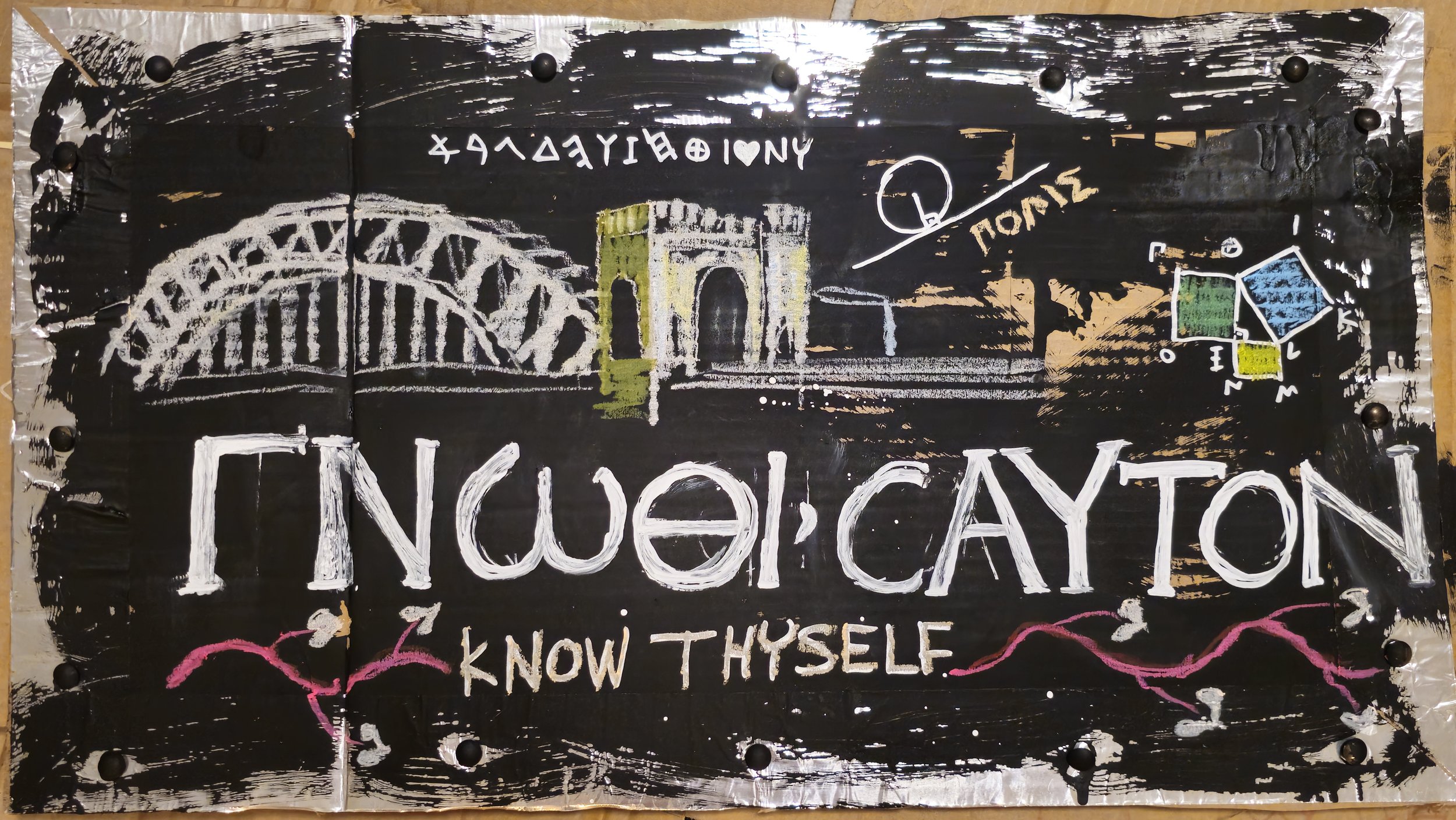
The maxim “gnōthi seauton.”
Know thyself.
Written at Delphi.
“Know thyself” was inscribed at Delphi and addressed, in the ancient tradition, to the individual. People from all over the ancient Greek world came to the Oracle at Delphi for cryptic messages, which needed interpretation. Self-knowledge became a major problem of Greek philosophy.
And the process runs both ways. Citizens internalize the attitudes, habits, and ways of the people around them. But when those same citizens collectively question and change their institutions, the polis acquires a way to examine itself.
So, gnōthi seauton was not only referring to the individual, but to an entire civilization:
“Athens, know thyself.”
I don’t know if I can find evidence that can support this hypothesis.
But then I remembered something interesting:
In the First Alcibiades, a dialogue attributed to Plato, Socrates connects knowing yourself directly with politics. Alcibiades wants to enter the affairs of the city, and Socrates tells him that before doing that he has to learn what he needs to know, beginning with himself.
That is not the same thing as collective self-knowledge. The leap from the citizen knowing himself or herself to the civilization knowing itself is mine.
When the citizens of a society repeatedly engage in looking at competing versions of themselves, their institutions become self-reflective too.
In theatre.
In the assembly.
In the courts.
In philosophy.
In mathematics.
One citizen makes a claim.
Another one opposes it.
And there is a third:
The chorus.
The audience.
The jury.
The citizens assembled.
The adjudicating public.
Not the same institution, not the same procedure, but I keep seeing the same structure.
And it does not happen once.
It happens again.
And again.
And again.
And it happens in both directions:
The citizen participates in an institution that reflects. Self-reflects.
And after doing this repeatedly, the institution becomes internalized into the human.
And then Athens learns to reflect through its citizens.
And the citizens learn to reflect through their polis.
This is also part of my hypothesis, and I have to see whether history supports it.
But if it does, then the connection among theatre, democracy, philosophy, mathematics, medicine, history, and the jury is deeper than the fact that they happened to flourish in the same city.
They were different ways in which a society learned to place itself in front of itself.
To look.
To argue.
To judge.
To change.
To know itself.
On my way home, I passed the film trucks again.
Cables, lights, carts of equipment. They were preparing to shoot a scene.
A few people had stopped on the sidewalk to watch them.
I stopped too.
And I watched them.
And Astoria has been doing this for more than a century.
There is a studio in the middle of Astoria. It opened in 1920. Rudolph Valentino filmed there. Gloria Swanson filmed there. The Marx Brothers made their first two talking pictures there. Today it is called Kaufman Astoria Studios, and Sesame Street is taped on its stages.
And beside it stands the Museum of the Moving Image. A whole museum about how we watch.
I did not need to walk to Athens this morning.
The neighborhood I am walking is the American theatron.
A polis, still watching itself.
What if indeed Athens invented not just democracy, but a society capable of watching itself think?