Walking Astoria #7
Essays and images exploring how societies shape mathematics and how mathematics shapes our world. A public notebook from my walks in Astoria, NYC, and beyond, as I research and write my book On the Origin of Mathematics: by Means of Social Selection.
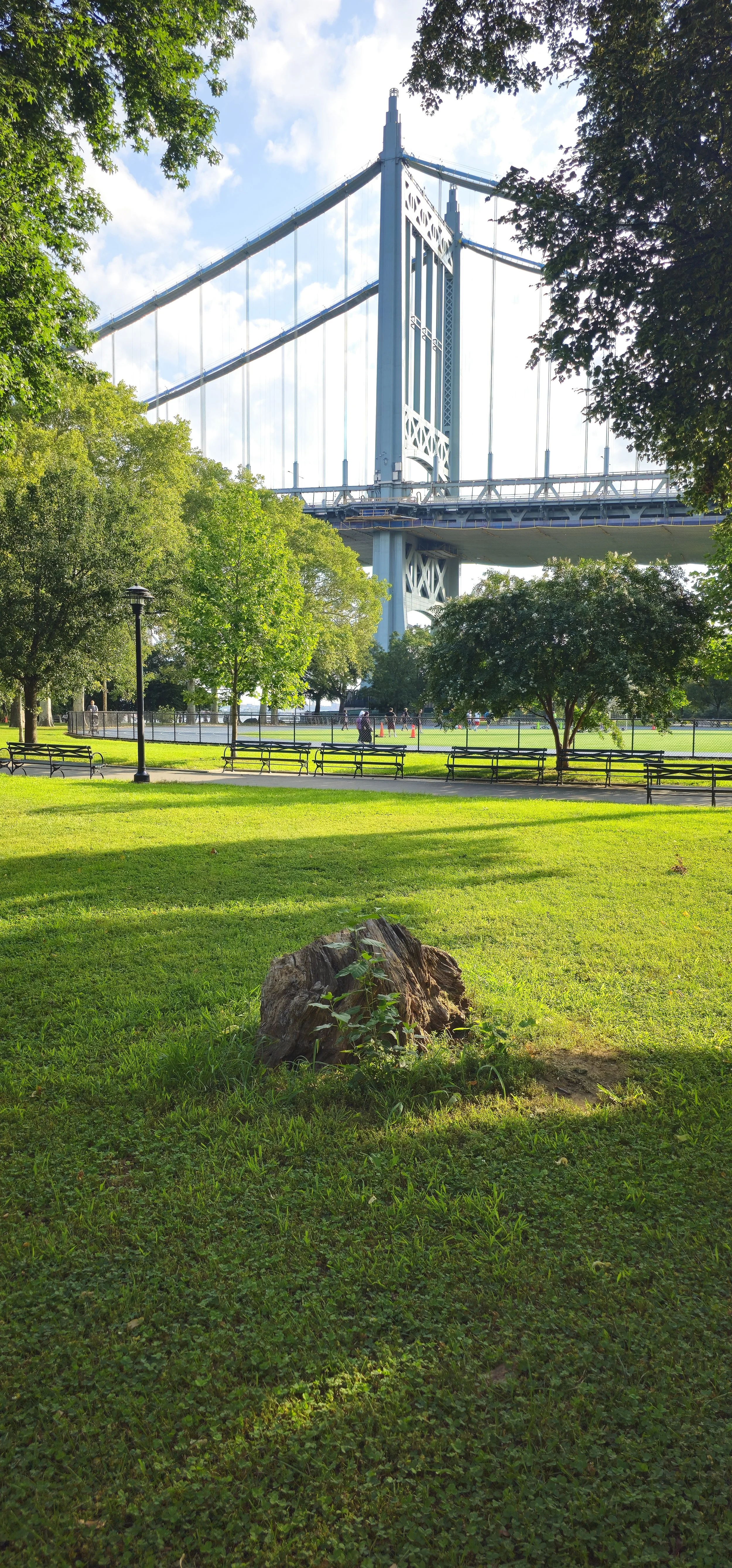
The Triborough Bridge as seen from the Running Track in Astoria Park
This morning I realized that I have been doing this for a week.
Seven walks.
The first one became You Are Here: On Maps and Origins.
I saw a map of Astoria Park, and I started wondering why we make maps in the first place.
Not only maps of territories. Myths are maps. Religions are maps. Scientific theories are maps.
We need them because we arrive in a world that was here before us, and immediately we start asking questions: Where am I? How did I get here? Who are all these people? Where did all this come from? What should I do next?
And that first walk brought me, at the end, to the first question behind the book I am trying to write: Why Athens? Why did all these maps, theatre, philosophy, mathematics, democracy, history, medicine, and the jury develop as institutions and flourish at the same time in the same place?
Then, in my second walk, in On Pebbles, Votes, Numbers, and Being Wrong, beginning my thoughts from the jury summons I received, I naively constructed a story: the public jury begins in Athens, travels to England, crosses the Atlantic, and eventually arrives in Queens in my mailbox.
Which is wrong.
The English jury did not descend from the Athenian one.
Similar solutions to similar societal pressures can emerge independently. In evolutionary biology, this phenomenon is called convergent evolution.
And this, among other observations that misled me, reminded me to always keep in mind that I might be wrong. Examining surviving words, texts, artifacts, and infrastructure as fossils of long-gone institutions, like a paleontologist of ideas, could lead me to the wrong conclusions. I have to remember that no matter how fruitful this method might be, it could also be misleading. Beautiful narratives are not necessarily accurate accounts of what actually happened.
Because, like with actual organisms, the fossil is just evidence from which we reconstruct the organism in our minds. A fossil is a trace of what once was an organism.
The same way that the map is not the territory, the fossil is not the organism.
The East River Is Not a River contains my thoughts during my third walk. Thinking constantly that I could be wrong and doubting everything could make me freeze.
And, yes, every fossil I examine could send my mind in the wrong direction, every map could be misleading, but at the end of the day, I still have to walk back home.
A doctor still has to make a diagnosis, a jury still has to decide, and a society still has to act.
And that brought me to Lawson and his idea of closure: We live in an open world, but to do anything in it, we have to hold something that is out there in the world in our minds. A closure is a built-in label, a boundary, or an object I hold in my mind to help me understand a specific part of the world. We might call it a river even if it’s a tidal strait, because it’s easier to think of it as a river. And if another question, another observation, another person, or another piece of evidence forces us to reopen the closure, we do so, and we call it a tidal strait.
We make closures to allow ourselves to act.
And we have to remember that all our closures are provisional. They can be reopened and reexamined.
And then I asked the question: What happens when my closure meets yours? And they differ?
And that took me into the next walk: A Polis Watching Itself.
And I started with ancient Greek tragedy. Of course I did.
On stage, two actors stand against each other, holding opposite positions. A chorus comments, and an audience watches and draws conclusions.
And remember that Greek theatre itself was a competition, judged by citizens.
The more I looked, the more I kept seeing versions of the same structure in tragedy, democracy, and the jury: at minimum, one person makes a claim, and another opposes it. And there is a third position. A plural position. That witnesses, judges, and decides:
The chorus.
The audience.
The jury.
The assembly.
Not the same institution, not the exact same procedure, but something keeps repeating.
And I remembered Castoriadis, The Imaginary Institution of Society, and his distinction between heteronomous and autonomous societies.
Heteronomous societies attribute the creation of their laws, governance, and institutions to an external power: God, the king, the emperor, or any other authority.
Autonomous societies recognize that their institutions are created by them and can therefore question, examine, and change them.
Something I left out of that walk was Vygotsky and his book, Mind in Society. Vygotsky develops the idea that higher psychological functions originate in social activity and are later internalized.
What first happens between people can become a process within the individual.
The child participates in speech with others before speech becomes something the child can use internally to organize thought and action.
In a way, thinking is internalized dialogue.
And I keep wondering whether something similar happens politically.
Here’s my hypothesis:
If you spend your life in a society where claims are made publicly, opposed publicly, judged publicly, become laws, and are reopened publicly, then perhaps eventually you internalize that process: I make a closure. Another voice, which is also mine, objects. I consider the evidence. I judge. I change my mind. I reopen the closure and make a new one. The polis becomes internalized in the citizen, and then the citizens go back out and change the polis.
The next morning, in The Wolf in the City, I stopped in front of a park sign. The same rules were written in English, Spanish, and Greek. Different languages, different histories, different people. But the same park, and the same rules.
And I started thinking that democracy does not require everybody to become the same.
Quite the opposite. It needs people who are different, but it also needs a shared procedure through which these different people can live together. People should respect and defend the Constitution and the laws: the law of the land.
You are free to disagree with the law.
You can protest it.
Challenge it.
Vote against it.
Try to change it.
The agreement is not that every closure is correct. The agreement is on how we make, challenge, adjudicate, and change our common closures.
Then I looked lower on the sign and saw the rules for dogs.
A dog is a domesticated wolf.
We domesticated plants, animals, and the land.
We built cities and discovered that we are still animals. We get angry. Fight for territory. Compete for status. We want revenge. We are certain we are right.
And I thought of civilization as the history of domesticating the human animal.
Civilization as self-domestication.
And that brought Aeschylus back again.
In the Oresteia, murder produces revenge, which produces another murder, which produces another claim for revenge, until Orestes arrives in Athens and Athena refuses to decide the case herself.
And she creates a jury. The conflict becomes argument. Evidence. Judgment.
The Furies do not disappear. They become the Eumenides. Tamed. Domesticated.
The wolf remains, but now it lives in the city. Tamed. Domesticated.
And yesterday, in On Education, or Democracy, and How You Can Keep It, I asked another question.
How does any of this survive us?
Every child arrives in a world already full of things built by other people: Language, numbers, roads, bridges, laws, stories, mathematics, the calendar, the Constitution.
Nobody starts from zero. Education is how the dead teach the living. The previous generations teach the next.
The Hell Gate Bridge stands over the East River as the realization of thousands of years of accumulated knowledge translated into steel.
The engineers who built it did not rediscover geometry, metallurgy, statics, and surveying from scratch. They inherited them.
But knowledge can be transmitted under almost any political system. A dictatorship can produce engineers and doctors.
Then Dewey gave me the distinction: Democracy is not just another way of governance. Democracy is primarily a mode of associated living, of shared, interconnected, and communicated experience.
You have to speak. Listen. Disagree. Give reasons. Hear the reasons of others. Judge. Accept a decision you may dislike. Try again.
And that is why the walk ended at the crossroads. Junctions like Miletus, Athens, Alexandria, Chang’an, Baghdad, Florence, Paris, or New York.
Places where people, languages, ideas, cultures, and worldviews encounter one another.
Aristotle was a transplant. Thales came from a trading city on the edge of different worlds, and maybe Phoenician by descent.
Because if everybody brings exactly the same assumptions and exactly the same answers, there is very little dialectic.
It is difference that creates variation.
And now, I realize that throughout the week I have been talking about inheritance too.
Words survive the people who first spoke them. Ideas survive their creators. Institutions survive the citizens who created them. Knowledge is passed to the next generation through education. New people inherit the world, modify it, and hand something different to whoever comes next.
Variation.
Inheritance.
This is starting to look suspiciously like evolution.
But for Darwin, variation is not enough.
His book was titled On the Origin of Species by Means of Natural Selection.
The species evolve, nature selects.
So, if ideas evolve, who selects them?
I kept walking.
And then I saw a desire path.
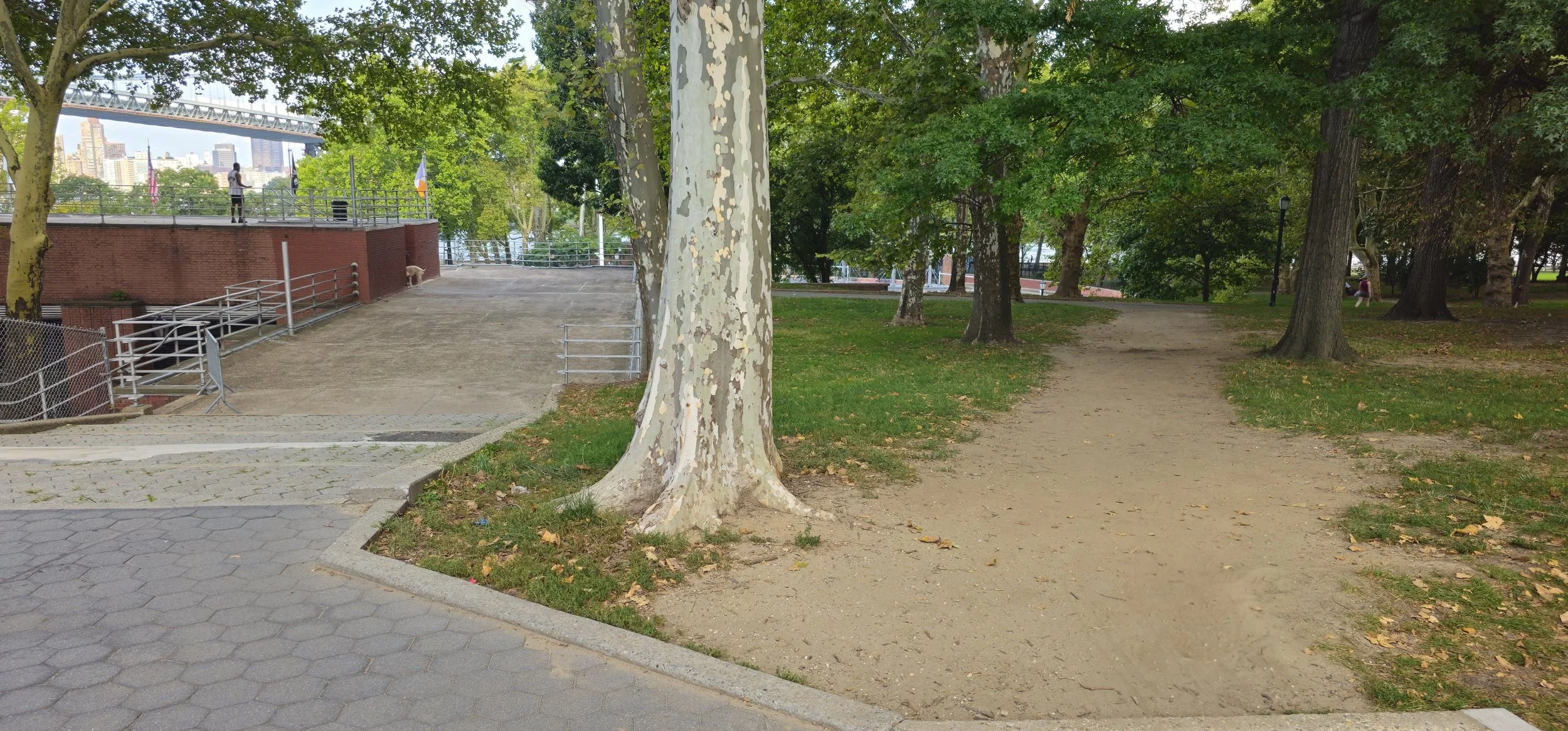
An official exit and an unofficial one. The stairs on the left. The path people made on the right.
There is an exit from Astoria Park here. The designers put stairs. They work perfectly well if you are walking. But if you are pushing a stroller, the stairs become a problem.
And people solved that problem.
Not by redesigning Astoria Park.
Not by writing a proposal.
Not by complaining.
They just kept pushing the strollers and walking through the grass.
Maybe someone carrying something did the same. Maybe somebody simply decided that this was where it made more sense to walk. Then another mother walked through with the stroller.
One stroller after the other.
Over and over again.
And the grass begins to disappear.
Eventually, there is a path.
This is called a desire path.
I love that name.
Of course, the designers had humans in mind.
But there was information they didn’t have.
Their map said the path is here.
And then the mothers said: “I don’t know about that.”
Except they did not say it.
They walked it.
Again, and again.
And again.
Until the objection became visible on the ground.
The official path is a closure: this is where people will go.
Then reality arrives, pushing a stroller.
And the closure reopens.
Mothers created the path.
Then the path begins influencing all walkers.
Something that people make becomes part of the environment, welcoming the next person.
Variation.
Selection.
Inheritance.
And then new variation again.
I kept walking and reached the skate park.
Yesterday, I looked at this place as a learning environment. Teenagers learn skateboarding by skateboarding.
Today I was looking at the skate park itself.
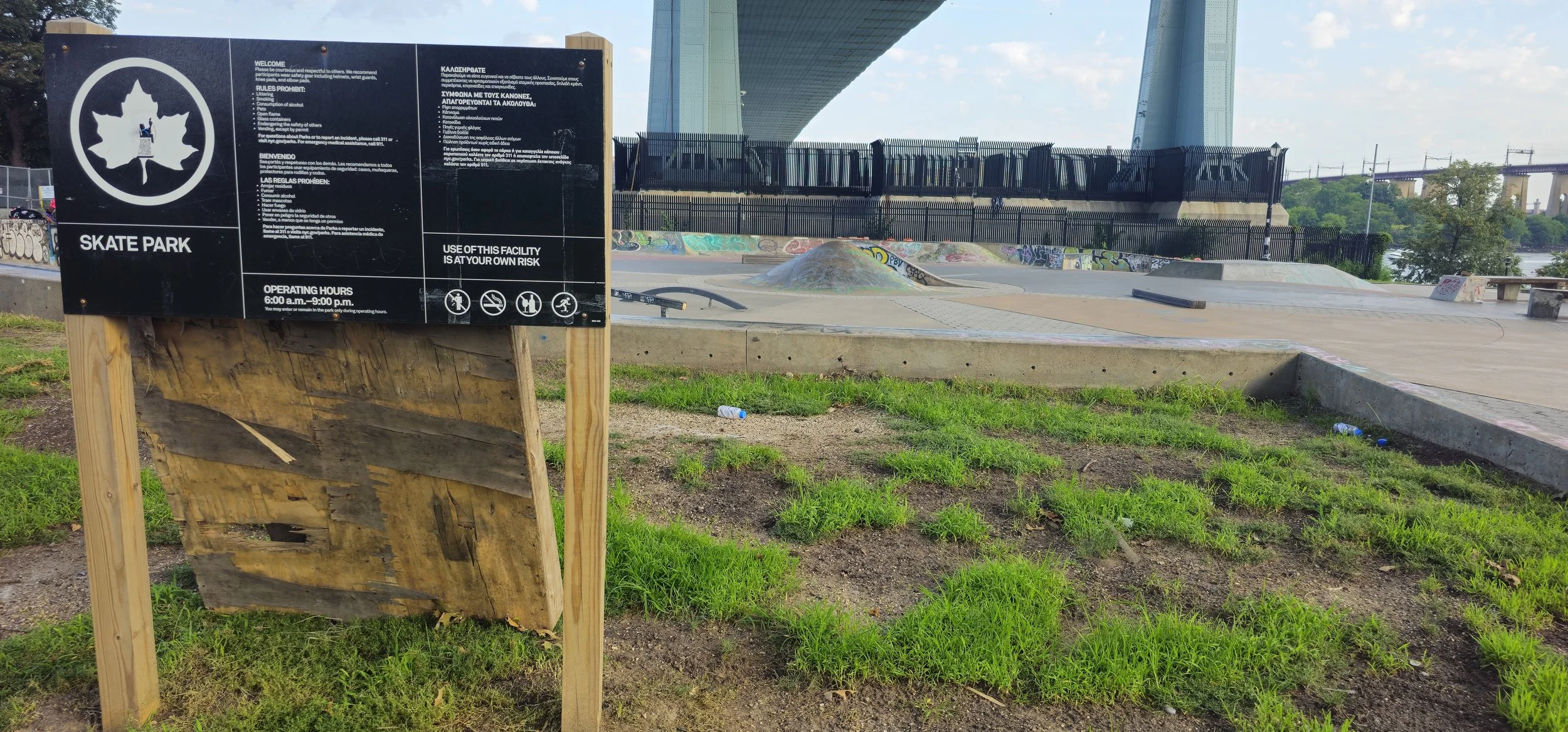
Astoria Skate Park
Astoria Park is much older than skateboarding. When designing the original park in the early twentieth century, no one had in mind a skate park.
But young people started doing something new. The park eventually changed with them.
Because of them.
And look at the difference between the desire path and this.
The desire path is still unofficial. Dirt through grass.
The skate park has crossed a threshold.
Concrete.
Ramps.
Rails.
A sign.
Rules.
It has entered the park. And it has entered the map.
A new behavior appeared. People kept doing it. The public environment eventually changed to accommodate it. And now a child who arrives in Astoria Park does not have to invent a place to skateboard. The place is already there.
Waiting.
Available.
Inherited.
Which is exactly what I was talking about yesterday.
And once you start seeing this, the same pattern appears at larger scales.
People want to move across something that is difficult to cross.
A river.
A strait.
A city.
Eventually, you get a bridge.
The Hell Gate Bridge allows trains across the East River.
The Triborough Bridge connects Queens, Manhattan, and the Bronx.
They accommodate the free movement of people and products.
And then the change becomes part of the world inherited by everybody who comes later.
That thought followed me north along the waterfront, toward Ralph DeMarco Park.
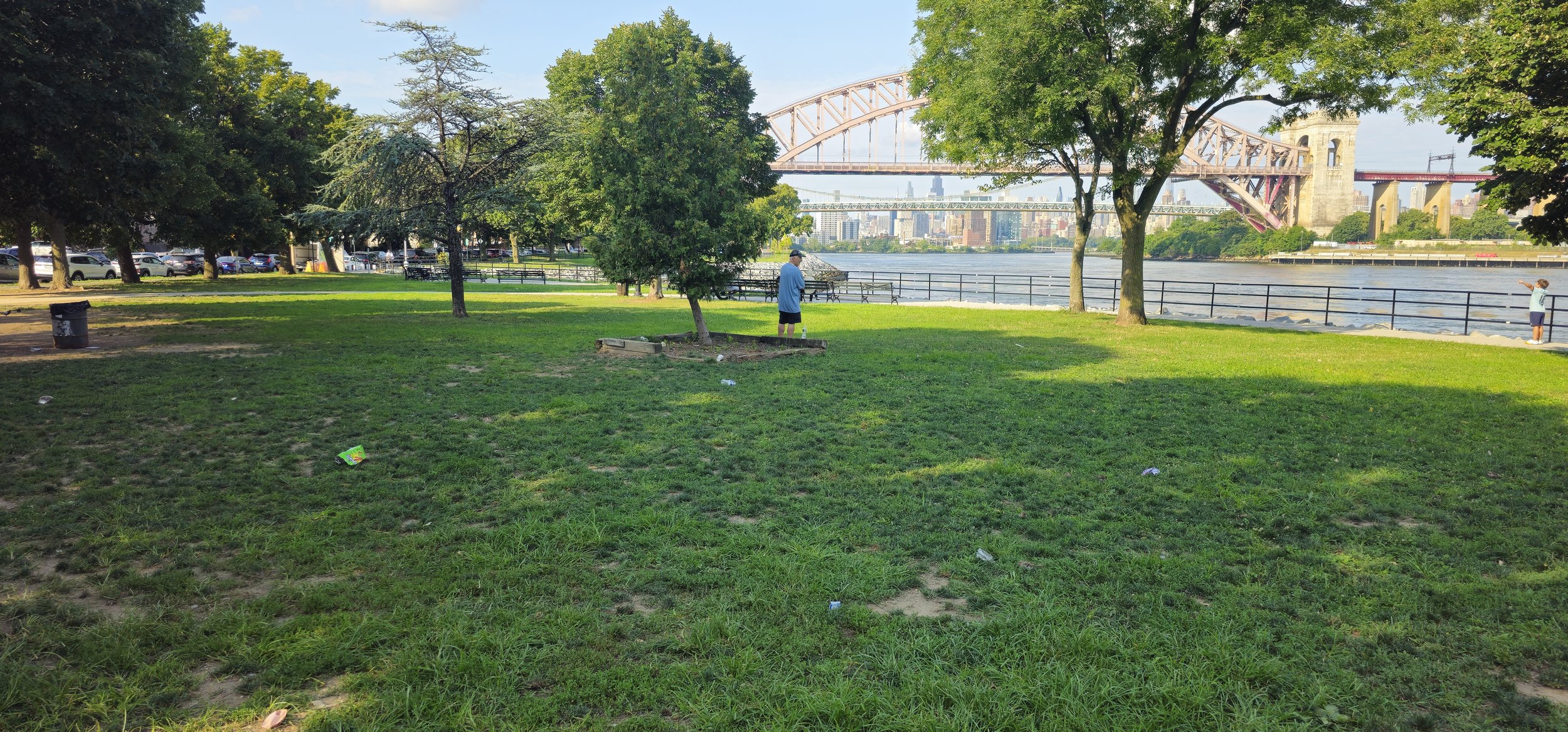
Ralph DeMarco Park, with Hell Gate Bridge behind it
When I first moved to Astoria, I remember this part of the waterfront being closed.
I didn’t really know what it was.
Later, I began walking there as if it had simply always been part of my neighborhood.
The need for a waterfront park had already been expressed.
Before I even knew I would move to New York.
People had already argued about what this piece of waterfront should become.
Somebody had proposed something.
There had been politics, decisions, funding, construction.
Then I moved to Astoria.
And now I walk here.
The decision was made before I became part of this place, but I inherited its consequences.
My daughter inherits them too.
So now I think I have an answer to the question I started with this morning.
Who selects?
The people.
“We the people”
People select through what they do. What they use. What they reject. What they repeat. What they stop doing. What they buy. What they teach. What they argue for. What they vote for. What they build. What they refuse to accept. What they pass on to their children.
But I have to be more precise.
Because a dictatorship selects too.
Censorship selects.
Propaganda selects.
Prisons select.
A king can decide what gets built.
A bureaucracy can decide what gets taught.
But something different happens in democracy.
The selection is distributed.
People can say:
This path does not work for me.
This law is wrong.
This explanation does not make sense.
This governor should leave.
This hypothesis has a problem.
This diagnosis does not fit the symptoms.
This story about what happened is contradicted by the evidence.
And then other people can reply.
Who is right?
Who decides?
And I am back in Athens.
Again.
People did mathematics long before democratic Athens. Egyptians measured. Babylonians calculated. People everywhere healed the sick, observed nature, told stories, created laws, argued about gods, justice, death, life, the universe, and everything.
My claim is not that Greeks invented thinking.
That would be ridiculous.
Something more specific happened.
In Athens, citizens increasingly lived inside institutions that required them to make claims publicly, listen to competing claims, judge between them, and live with the consequences of their decisions.
And I think that changed the selection environment for ideas.
So perhaps this is the connection I have been looking for since the first walk.
Why Athens?
Why theatre, philosophy, mathematics, democracy, medicine, history, the jury?
They were different products of the same social environment.
A society increasingly organized around making things public. There were claims. Rational arguments. Evidence. Conflict. Judgment. And, when needed, revision.
A society in which ideas had to survive contact with other ideas.
If so, democracy did something more consequential than give citizens a form of government.
It changed the selection pressure.
And perhaps that is why the production of ideas accelerated.
Not because Athens had some magical ingredient in the water that turned humans into philosophers.
And not because Zeus was turning herders into mathematicians through epiphany. He was too busy cheating on Hera.
But because more claims could enter the public agōn, encounter opposition, rational examination, be judged, fail or survive, change, recombine, and be tried again.
Variation became public.
Selection became social.
What survived could be inherited.
Darwin asked how species emerge without somebody designing them in advance.
Variation appears.
The natural environment selects.
Some variations survive and reproduce.
Over time, something new emerges.
I am treating ideas like Darwinian species.
Where do they come from?
Why do some survive?
Why do others disappear?
How do they change?
How does what survives become part of the environment inherited by the next generation?
And what kind of social environment accelerates this process?
The book I am trying to write is called On the Origin of Ideas by Means of Social Selection.
In my book, I will claim that democracy accelerates both variation and social selection.
Democracy allows the people to propose another route.
To oppose the official one.
To rationally examine.
To judge.
To reopen the decision.
To redraw the map.
To see what happens.
Democracy does not guarantee that we will choose the right path.
It guarantees something more modest.
And maybe more important.
We can choose the path we desire.
A democratic society allows people to walk freely on their desired paths.
And if enough people keep walking there for long enough, the new path can eventually become part of the map.