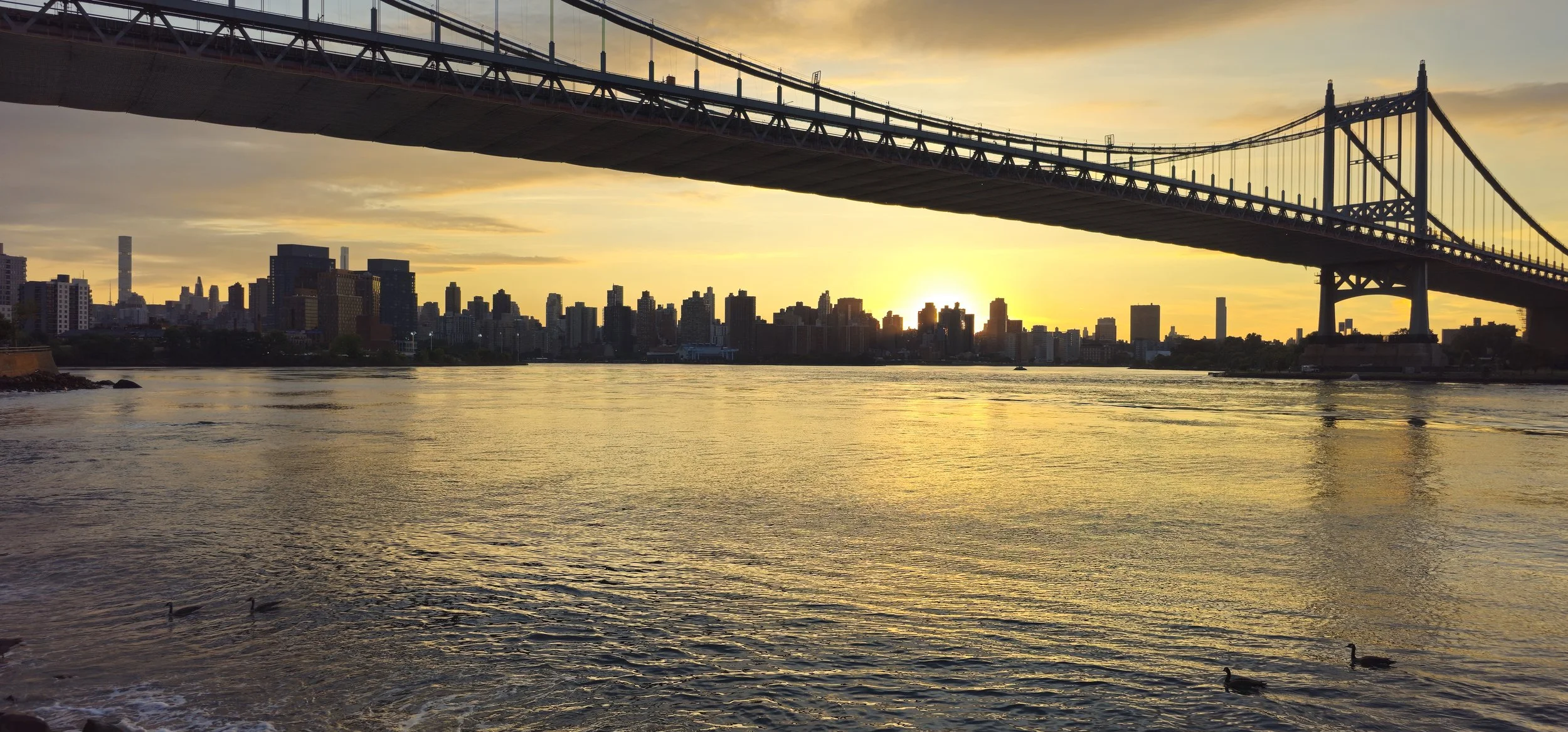
Walking Astoria #9
Essays and images exploring how societies shape mathematics and how mathematics shapes our world. A public notebook from my walks in Astoria, NYC, and beyond, as I research and write my book On the Origin of Mathematics: by Means of Social Selection.
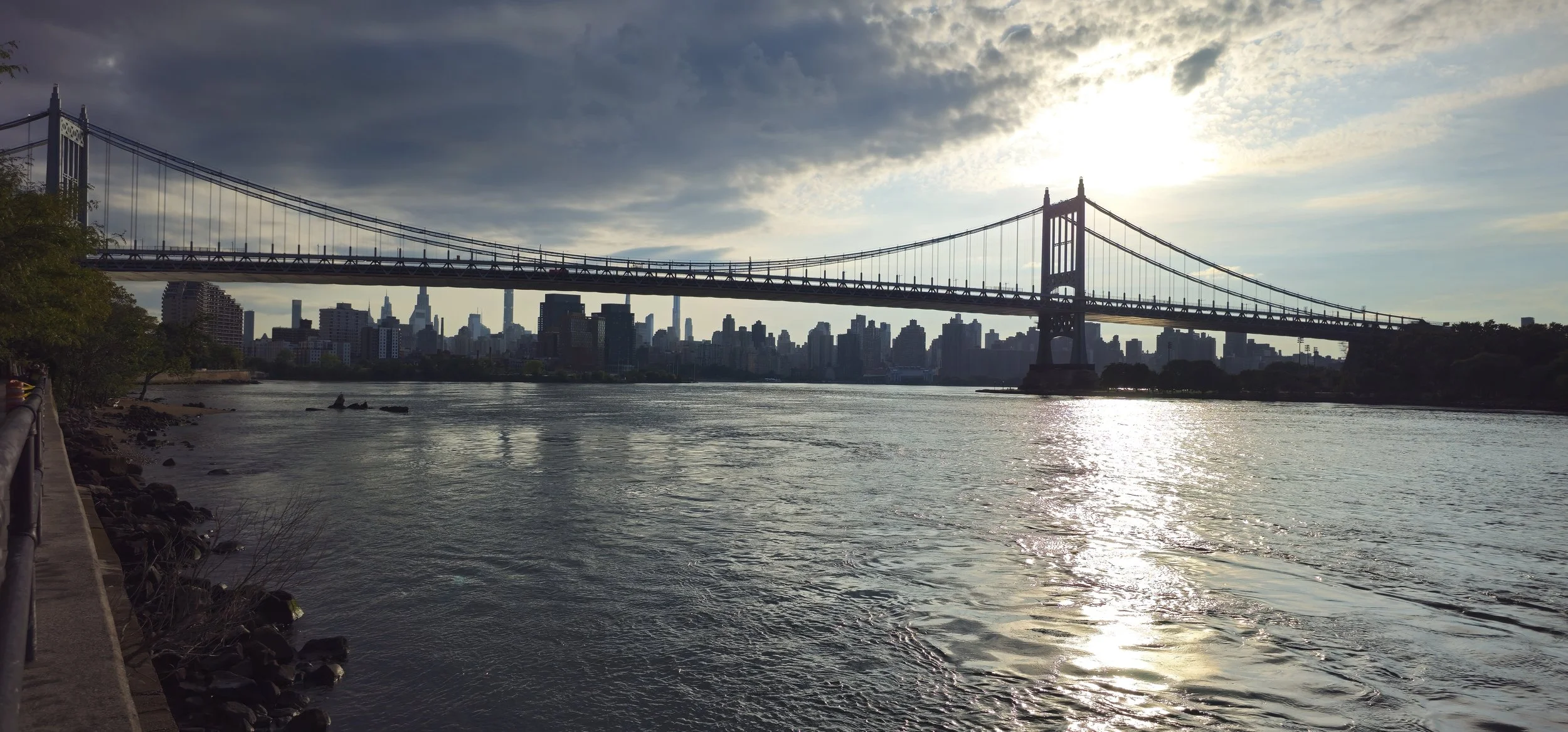
The Triborough Bridge
I was thinking of desire paths two days ago.
One of those paths that starts to appear when humans decide they need a better way.
If enough people keep walking there, day after day, the grass little by little disappears, and a new path is formed.
And yesterday, I arrived at the obvious conclusion that a city is not its buildings. It’s not even its territory. The city is its people. Athens was the Athenians. And the United States is “we the people.”
And we saw an obvious problem: as soon as you say “we,” we have to answer the question, who is included in that “we?”
And also, what happens when those who are excluded insist that they belong there too?
A democracy, a healthy democracy, has to have an answer. It should include a process through which the excluded can speak, argue, protest, vote, persuade, organize, and eventually force the political map to include them.
And a constitution with amendments is an admission that the map is not perfect or final.
And therefore, it can be reopened.
But what happens when the map refuses to include the desire path we the people are creating?
A revolution.
A revolution with barricades, gunpowder, crowds, burning flags, and toppling of statues.
But before a revolution becomes that explosive, it’s just a blockage. People who keep trying to move in one direction, and power that keeps insisting that they should stay in another.
And remember, civilization, law, and democracy do not abolish human violence.
The capacity for violence remains in the people. In every one of us, and it is even uglier in all of us together.
What civilization, law, and democracy do, when they work, is domesticate human violence.
They take all this raw, ugly, collective energy that in another age would have become feud, riot, coup, or civil war, and transform it into its domesticated form:
Assault into argument.
Force into vote.
Vengeance into court.
Violence into law.
Insurrection into protest.
Overthrow into Amendment.
And then, I started thinking of how democracy does that. How does democracy domesticate violence?
And I formed a hypothesis: democracy domesticates violence by distributing agency.
And I don’t mean agency as just the right to have an opinion.
Everyone has many already.
Agency means having a real share in the life of the polis.
But true agency also requires inclusive structures, not just formal citizenship. It requires real co-ownership of collective life. It requires distribution.
All citizens should have:
A share in voice.
A share in knowledge.
A share in judgment.
A share in the decision.
A share in opportunity.
A share in both the benefits and the burdens of living together.
Therefore, constant redistribution of these shares is the perpetual work of democracy.
But,
if decisions are distributed but knowledge is concentrated,
if voting is distributed but wealth and effective power are radically concentrated,
if people are told they belong to the “we,” but the structures remain inaccessible to them,
then democracy becomes fragile, performative, rigged, and the “we” stops being a promise and becomes a slogan.
When agency becomes concentrated again, violence begins leaking back into the system.
But then I realized something.
I had been thinking about revolution as something that happens when democracy fails.
What if I have this partly backward?
Because when I started looking at the history, revolution did not appear only at the end of a democracy.
Time and again, it appeared before democracy.
Before people could change the map from within the system, they had to break the old map first.
Before an autonomous society emerges, there is a heteronomous one.
And I went back to Greece.
Again.
Of course.
I first thought of Miletus.
I had in my mind that democracy appeared there through the Ionian Revolt, and perhaps that this happened before Athens.
Except it didn't.
Athens came first.
But before Athens, another polis:
Samos.
Around 522 BCE, after the death of tyrant Polycrates, Maeandrius was the one holding power.
Herodotus tells us that Maeandrius called the citizens’ assembly and announced that he did not want to rule over people who were no different from himself. That he would give power and equality to the people.
Isonomia: Equality under the law.
That lasted for a few minutes.
One of the citizens challenged him, demanding that he account for the money he had handled under Polycrates.
Maeandrius just discovered that equality is much more attractive before somebody uses it against you.
And right there and then, he changed his mind and arrested his opponents.
So, no democracy in Samos.
But something is already there.
A ruler saying that one man should not rule over other men like himself, that power should be shared and distributed.
And people were given the opportunity to question him.
And then, Athens.
In 508 or 507 BCE, Cleisthenes and Isagoras were fighting for the political control of Athens.
Isagoras had the support of Sparta. Cleisthenes was expelled. Hundreds of Athenian families were expelled also. And Isagoras tried to dissolve the Council.
But the Athenians revolted.
Ordinary citizens resisted.
They trapped Isagoras and his Spartan supporters on the Acropolis.
After a few days, the Spartans were allowed to leave, and Cleisthenes returned.
And then came the reforms I have been talking about throughout these walks.
The demes. The ten tribes. The Council of Five Hundred.
A political structure that distributed participation.
There is actually a name for what happened in 508/507 BCE in modern scholarship:
The Athenian Revolution.
Cleisthenes redesigned the political map. But the people made it possible.
And now I started wondering whether this was just Greece.
It wasn't.
England.
There, the story goes like this:
There was a Civil War in the seventeenth century.
The king, Charles I, fought Parliament.
The king lost.
And then the English did something unthinkable:
They put their king on trial.
And then, they executed him.
The wild animal escaped domestication.
England became a republic.
At least for a while.
Then Cromwell concentrated power again.
And then, finally, the monarchy returned.
But then,
in 1688,
another revolution.
The Glorious Revolution.
And after that, the king could no longer rule in the same way.
The Parliament became much more powerful.
And then the Bill of Rights limited the monarchy.
England wasn’t a democracy yet.
Most people still couldn’t vote.
But power had moved.
During the Civil War, the Levellers were already asking who should vote. And how broadly power should be distributed.
Again: Conflict. Revolution.
And then some redistribution of political agency.
And then,
America.
The United States began with a revolution.
The American Revolution.
And the Declaration of Independence:
Governments derive their powers from the consent of the governed. And when a government becomes destructive of the purposes for which it exists, the people have the right to change it. Or abolish it.
A revolution is writing a justification into the document explaining why it revolted.
Written like a Euclidean proof.
But that is for another walk.
So, the Americans built a republic.
But, as I said yesterday, there was a problem with the “we.”
Women were not part of the political “we,” enslaved people certainly were not, Native Americans were not, and many poor white men could not initially vote, because of property requirements, of course.
But the map had changed.
And then,
there was France.
Another revolution.
And the story goes like this:
The monarchy is attacked.
And then,
la Déclaration des droits de l'Homme et du citoyen de 1789
The Declaration of the Rights of Man and of the Citizen of 1789.
It declares that people are born free and equal in rights and that sovereignty belongs to the nation.
And, a few years later, France becomes a republic.
And then came the Terror.
Then came Napoleon.
Once again, revolution does not guarantee democracy.
It can break the old concentration of power and then create a new one.
And across the Atlantic, in the French colony of Saint-Domingue, enslaved people heard all this talk about liberty and equality.
And they took it seriously.
And in 1791, they revolted.
After thirteen years of war, Haiti became independent, and slavery ended.
But Haiti also reminds me to be careful.
A successful revolution does not automatically become a democracy.
Independence is not democracy.
So, I cannot say that revolution always leads to democracy, or that democracy comes only through revolution. There are democracies that developed much more gradually.
Britain itself expanded the franchise gradually, through the Reform Acts of 1832, 1867, and 1884. Not through one democratic revolution, but through repeated reform.
By now, I kept coming back to the same word: distribution.
But the story does not stop with France and Haiti.
Once this idea was out there, it kept moving.
America, France, and Haiti had demonstrated something that could no longer be forgotten.
The Greek Revolution came in 1821.
And then, in 1848, revolutions broke out almost everywhere in Europe: France, the German states, Austria, Hungary, and Italy.
Different places. Different demands. Constitutions. Representation. National independence. More people demanding some share of political power.
Most of those revolutions failed, many of them quickly. Kings remained kings. Empires survived. Armies suppressed the revolts.
But something had changed.
And 1848 is also the year that Marx and Engels published The Communist Manifesto.
Marx looked at what was happening around him and saw another concentration of power. The new industrial economy had created enormous wealth. But it had also concentrated much of that wealth and power in relatively few hands. The workers helped produce it, but they had no share in deciding how that world would work.
Then, in 1871, in Paris, after France had lost a war against Prussia, Napoleon III was gone. And for a little more than two months, Paris tried something: La Commune de Paris.
The Paris Commune.
The people of Paris elected a council and tried to govern the city themselves.
It did not last. The French government crushed it. Thousands died.
And then in 1905, the Russian Empire was still ruled by a Tsar. Political power was extraordinarily concentrated. There were very few legal ways for workers and ordinary people to influence the government.
And then came the strikes, the protests, and then: Кровавое воскресенье
Bloody Sunday.
Revolt.
And during the strikes, workers began creating something interesting:
Советы: soviets, councils of workers.
People in factories elected representatives. The representatives met, discussed what to do, coordinated the strikes, and made decisions. But the Revolution of 1905 failed.
The Tsar remained, the soviets were suppressed, but the idea did not disappear.
Twelve years later, in 1917, they came back.
And the Tsar fell. And all over Russia, workers and soldiers began organizing themselves into soviets again.
For a few months, Russia had two centers of power: The Provisional Government and the soviets. The official government had the formal authority, but the soviets had authority among workers and soldiers.
And this is where the story becomes very interesting for what I am trying to understand.
Because the soviets, in their original form, were a form of distributed political agency.
And here I stopped again.
And I thought:
Workers had councils, soldiers had councils, people elected delegates, they argued, they decided, and power was moving outward.
This was distribution.
Lenin had proclaimed, "all power to the soviets," the Bolsheviks gained support, and by 1917, they had won majorities in important soviets.
And then they took power in their name. And then power started moving in the other direction. Back inward. Toward the Bolshevik Party. Toward its leadership.
The Constituent Assembly was elected.
The Bolsheviks did not win a majority.
And when the Assembly met in January 1918, it was dissolved.
During the Civil War that followed, other political parties were suppressed, the state became more centralized, the soviets continued to exist, and the country would eventually even take their name: The Soviet Union.
But the power that had made the first soviets so interesting was becoming less and less distributed. And then, in 1921, at Kronstadt, sailors and others rebelled against the Bolshevik government.
Among the things they demanded were new, free elections to the soviets.
Think about that.
A revolution had created councils to distribute political agency.
A party had taken power, promising all power to the soviets.
And only four years later, people were revolting against that government, demanding that the soviets become free again.
And the Bolshevik government crushed the revolt. Of course they did.
And we are back where we started:
Distribution.
Maybe the most important question after a revolution is not simply whether the revolution succeeds.
Maybe the question is: Where does the power go afterward?
A revolution can destroy a concentration of power. But if the power becomes concentrated somewhere else again, what exactly has changed?
The names have changed. The distribution has not.
And maybe this is the connection I was looking for between revolution and democracy.
Before democracy exists, revolution can be one way that concentrated power is broken and distributed.
But democracy has another job after that: It has to keep power distributed.
Not only the vote.
But, agency, knowledge, judgment, decision, opportunity.
And, yes, some meaningful share of the wealth and the benefits that society produces.
Not everybody is getting exactly the same thing, but everybody is actually getting a share.
Everybody belongs to the "we."
Because the animal did not disappear.
We domesticated it.
And when people have ways to argue, vote, protest, organize, challenge, reopen decisions, and actually change something, violence has somewhere else to go.
But when those paths stop working, when power concentrates again, when governments hear their citizens but no longer heed them, the domestication begins to disappear.
And the old animal starts coming back.
At first, it leaks: a strike, a protest, civil disobedience, a riot, political rage, revolt.
And sometimes revolution.
So maybe democracy and revolution are connected in both directions.
Sometimes revolution comes before democracy because power has to be distributed.
And democracy exists afterward to keep another revolution from becoming necessary.
By keeping power distributed.
By keeping the map open.
Because people will keep making desire paths.
The question is whether the government can see them.
Whether it can listen.
Whether it can change the map before the people have to tear it up.